
Description
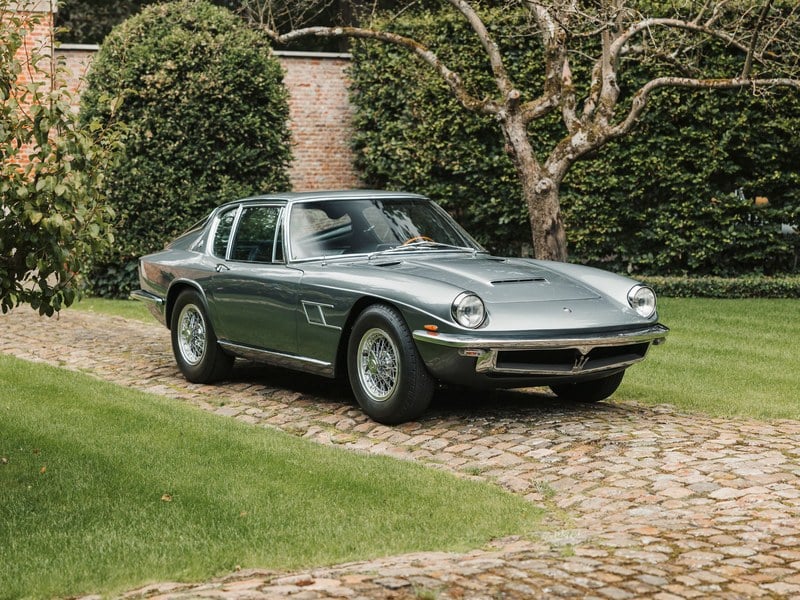
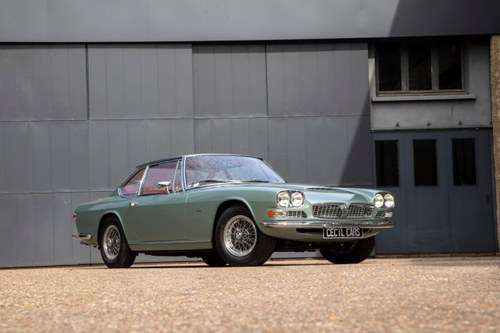
Model history: Maserati named the Mexico after its victory in the 1966 Mexican Grand Prix. It made its debut at the Turin Motor Show that same year. The Mexico replaced the four-seater coupé with the six-cylinder Sebring engine. Maserati gave it a V8 engine and elegant bodywork by Vignale. The 4. 7-litre V8 produced 290 bhp and reached speeds of 225 km/ h, or even 240 km/ h according to some sources. Maserati also offered a more economical 4. 2-litre version. With the exception of its rigid rear axle, the Mexico was based on the Quattroporte saloon. It had independent front suspension, four disc brakes, a five-speed ZF gearbox and an optional automatic transmission. Maserati ceased production in 1973 after 480 examples. This made the contemporary Ghibli, with 1, 274 units, almost commonplace by comparison. History of this Frua prototype Maserati: This Maserati Mexico is an exclusive Frua creation, the more attractive of two different proposals. The relationship between coachbuilder Frua and Maserati gave rise to a number of bespoke creations that are among the most elegant of the trident-patterned non-standard models. He created two cars with similar bodywork but completely different front-end treatments, the second featuring a front end with strange headlights and a 4. 2-litre engine. In 1968, Frua premiered this model, but without the engine as it was not yet finished. Its original paintwork was a very light green, which it wears again today. The original red leather interior also remains intact. After the Geneva Show, Frua kept the car until December 1969 before sending it back to the Maserati factory, where it left in March 1970, two years after its presentation in Geneva, equipped with power steering, air conditioning and a radio. It was finally delivered to Auto Paris, the Spanish importer based in Barcelona. After being repainted in silver, fitted with Quattroporte taillights, and having had three other Spanish owners, it was bought by a great Maserati enthusiast in Barcelona, and in August 2013 Maserati historian Marc Sonnery appraised it in Barcelona. A Belgian collector then acquired it and sent it to Brussels for a complete bodywork restoration. During stripping, several layers of paint were uncovered, confirming the original water-green colour and the celestial blue noted on the factory delivery note. The interior and mechanics were in excellent condition and required very little maintenance. After being presented at the award-winning 'Salon Privé' in London in 2014, it was exhibited at the first Chantilly Concours d'Elegance in 2014. It was during the Maserati Centenary organised by the factory, the most important gathering of classic Maseratis of all time, that it received no less than the 'Best of Show' award. Finally, a month later, it won its category at the Zoute competition in Belgium. Body: In 2013, in Belgium, it was completely restored and repainted in the light green it was presented in at the 1968 Geneva Motor Show. Upholstery: It still has its original red leather upholstery, which is in perfect condition. Engine: Its 4. 7-litre V8 engine is in perfect working order with very good oil pressure. Gearbox: Original ZF 5-speed gearbox, in excellent working order. No play, gears shift perfectly. Running gear: The front axle is stable, very good road holding. The handling is perfect. There is no play or noise. The suspension is perfect. Brakes: Fitted with 4 disc brakes with 4-piston shoes at the front for greater braking efficiency. Special features: - Car presented at the 1968 Geneva Motor Show - Awarded a prize at the 2014 London Private Show - "Best of Show" for the Maserati centenary Price: €700, 000