Beschreibung
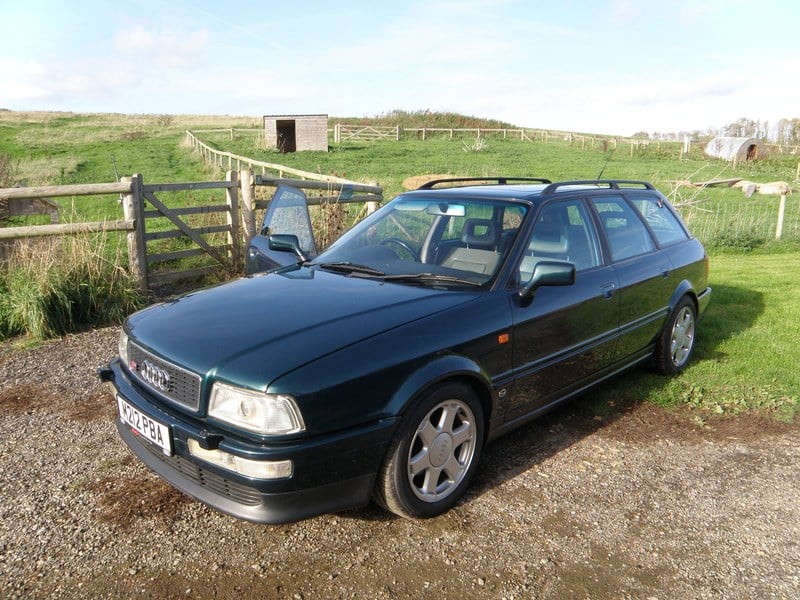
The 90 20V Sport – a light and agile performance executive saloon described as a ‘Tiger Cat’ in front wheel drive form by Volkswagen Audi CAR magazine's article in July 1990, and went on to say "the manner of its acceleration is quite dazzling". Audi's 90 model launch was hailed by the motoring press for its drivability, aerodynamics and engineering technical excellence. This car, H523 XBD pictured above, is for sale after 20 years in the same ownership, in near immaculate condition inside and out - entirely unmodified, and in original factory specification. With 120kg less weight to carry than the quattro option, it is faster and has sharper handling, giving a better driving experience in all but the worst of road conditions.
Audi’s in-line i5 cylinder engine DNA lineage has evolved directly from Audi’s rally sport heritage. The distinctive sound of the snarling growl from the five cylinders is as recognisable and evocative today as it ever was. The 90 20V Sport, in quattro and non-quattro options, should receive far more credit than it has to date, as a race proven thoroughbred with the legendary i5 20V engine code 7A, at its heart.
This is likely to be the only 90 20V Sport with the 7A engine maintained as an unmodified fully original car to factory specification, remaining on the road today - in quattro or non-quattro form. This car was first in the hands of VAG UK in Milton Keynes for 9 months from August 1990, still has the original VAG plates and is thought to be one of Audi UK’s ‘Press Cars’ used for marketing and test drives. There are only two previous owners including VAG UK. See audi9020v. com website.
Audi AG International Customer Services record that all Audi 90 models fitted with the 20V 7A engine were a limited production run of only 6, 212 in total, between 1989 - 91, of which only 1, 642 (25%) were in the front wheel drive option from 1990-91, and 4, 750 (75%) in quattro option from 1989-91.
The majority (84%) of the total produced were the non - Sport, lower specification models. Only 1000 (16%) of this limited overall production run of 6, 212 were manufactured in the enhanced Sport specification for both drive options, for which we can reasonably say 500 were made initially for the quattro, and 500 for the non-quattro option.
It is thought that just 184 of the 1000 Sports were imported into the UK in equal numbers of the quattro and non-quattro cars of 92 each, the rest being sold in continental Europe and a variation, not badged as a Sport, for the North American market. The USA and Canadian imports were different to the European specification, having a slightly lower power output to meet emissions requirements, revised front bumpers for more onerous crash tests, were almost entirely in automatic transmission (the European Sport was manual only) and badged as the 90 20V 2. 3 E. I haven't been able to verify if the interior, brakes and suspension were of the same specification as the Sport.
These startling, low production figures, made the 90 20V Sport an extremely rare limited edition - even when new. Only producing 500 in each drive variant is remarkable and represented the state of the art for Audi at that time - vorsprung durch technik (advancement through technology), a phrase no longer used by Audi since 2016.
Current UK numbers licensed on the road according to 'How many left' website are:
Audi 90 20V quattro Sport – 10
Audi 90 20V Sport – 3
The production of the new A4 from 1994, together, two years earlier, with the release of the much heavier 80 series four (described as a 'heavyweight' by MotorSport magazine), and the new Coupes, both optioned with the V6 2. 8 litre engines (but managing only another 4 bhp) replacing the i5 2. 3 litre 20V's, ended the era of the 80, 90, 100 and 200 series cars.
This front wheel drive model H523 XBD in Tornado Red is significantly quicker in most driving conditions due to being 120Kg lighter without the heavy 1980's quattro mechanicals of the time, which enables a 10% greater power to weight ratio. With a gear box ratio better matched to the character of the engine and less power transmission loss, its handling is very responsive, precise and more agile. Significantly quicker 0-60mph acceleration is reached in second gear with faster through-gears acceleration at all speeds, defining this model's character. With the weight of the engine over the driving wheels and a 55/ 45 weight distribution front to rear it’s pretty well balanced (the quattro was closer to 50/ 50 due to the increased weight of the rear axle), and the rest is down to driving technique and experience to work with the character of the car.
The acceleration test figures recorded by Volkswagen Audi CAR magazine in July 1990, for the lighter front wheel drive 'Tiger Cat' model, was 7. 6 seconds to 60mph – a hugely more impressive performance of 1. 3 seconds quicker than the heavier quattro, previously tested by the magazine and published in September 1989. Interesting to note that Audi claimed the non-quattro’s acceleration was 0. 2 seconds slower – maybe on slippery surfaces, but this wasn’t mentioned. Was this an intervention by the Audi marketing team to protect the Quattro brand still fresh from the rally wins of the mid 80's? Maybe the marketing people did believe they had to protect the Quattro brand... but thankfully the review in Volkswagen Audi CAR magazine put the record straight and reported their road test figures - letting the (tiger) cat out of the bag.
At 1, 320kg versus 1, 200kg, the quattro model's extra weight and a gear box designed with different ratios, less well matched to the engine, requires a change to third gear to reach 60mph. These combined factors reduce acceleration performance, responsiveness and agility, in all but the worst of road conditions.
The Audi 90 has a drag coefficient of 0. 29 which made this model ‘Best in class’ in the world in 1989. The Tiger Cat achieved 139 mph average top speed in tests - a realistically achievable 140mph. With its low, slippery shape and steeply raked windscreen, the car maintains compete stability and control at high speeds. There are no specific wind tunnel figures for the 20V Sport, but sitting 25mm lower, it must have a better coefficient than the class-leading record.
Volkswagen Audi CAR magazine said of the front wheel drive model "Handling, too, is outstanding. Front suspension differs from the other 90s (and from the 20V Coupes) in that the front wishbones are forged rather than being fabricated from sheet steel and its anti-roll bar is thicker, 24mm instead of 21. Allied to lowered suspension with Boge gas dampers, the overall result is excellent, with handling beautifully balanced at all speeds." The 20V Coupes inherited the forged wishbones from 1992.
The 90 20V Sport was only available in red, black and white and was supplied with a manual gear box.
The Sport's vented front disc brakes are larger, at 276mm diameter, the callipers have twin asymmetrical pistons giving powerful and confidence-inspiring progressive stopping performance in all conditions. On test, the car achieved 36. 8 mpg when driven "economically" which is 10% better than the quattro option.
H523 XBD was registered new in August 1990, model code 8A, engine code 7A, and has the Series 3, B3 chassis. The 90 20V has the lightest of all the B3 chassis, contributing to a beautifully balanced car.
This is the 2309cc fuel injected engine. Power output is 125kw (170bhp) @ 6, 000rpm with 220Nm of torque @ 4, 500rpm and a compression ratio of 10. 3:1. The sublime, growling sound of the engine comes from the race-proven 20 valve 5 cylinders in-line layout, with a light alloy cylinder head double overhead camshaft valve train (DOHC), tubular manifold, catalytic converter (not legally required for another four years in the UK) and twin exhaust.
Equipment spec for the Sport included a factory fitted tilt/ slide metal sunroof, ski bag and heated electrically adjustable blue tint wing mirrors painted in matching body colour. Audi Entertainment sound system – the original Blaupunkt radio cassette player has never been changed. The aerial is set into the heated rear window. The interior is all black finishes with Sport front seats and 45 degree stripes to jacquard satin seat trim, leather gear shift gaiter and stitched leather steering wheel.
Three circular dials in the centre console (oil pressure, oil temperature and alternator) define the last years of an analogue age now passed. A selectable ABS switch was included for driving in deep fresh snow - with the ABS off this enabled better traction. Electric front windows, all the glass is blue tinted, and with a green sun-glare band across the top of the windscreen.
The exterior has all black trims (full factory de-chrome) including side strips. Colour matched bumpers with split finish ‘orange peel’ and smooth finish. An aerospace technology 'hydro-forged' hollow aluminium rear aerofoil painted in matching body colour was manufactured for this model only, and never repeated due to the excessive cost. The wheels are the distinctive Speedline 15" x 7J 'split rim' spec, and were an inch wider than the non-Sport 6J Ronals.
A cherished, much cared-for car, and importantly, in unmodified factory specification, makes this unique. Owned by me for 20 years since 1997, with just two previous owners - originally a VAG 'Press' car in Milton Keynes for the first 9 months of its life. All in extremely good condition inside and out, all thoroughly original - one of only a handful of remaining 7A engine 90 20V Sport models registered on the road today in the UK or Europe. With the rate of loss year on year, currently standing at 3 in the front wheel drive option and 10 in the quattro option, this could soon be the only one left on the road in the UK.
The MOT is valid until April 2018, 143, 000 careful miles, always garaged, very comprehensive FSH and mostly VW Audi main dealer stamps, no expenses spared. Various spare parts including a new factory supplied front wing which I haven't yet fitted (there is slight corrosion on the rim of the OSF wing).
Recent work and full service carried out in Spring this year includes a new windscreen, front brake discs, rubber brake hoses, master cylinder, specialist re-build of front callipers by Brake Calliper Specialists of Nottingham finished in aviation paint (I've fitted high performance pads which don't count as a modification), cam and aux belts replaced, new water pump, battery, oil, filter and brake fluid replaced.
This rare car still drives and handles like new, looks great, sounds great, and is good enough to be show-cased at classic events. Power, lightness, beautifully balanced agility and a classic, distinctive design, continues to turn heads today; this is Audi's "Tiger Cat".
In 2007 the car sustained a minor rear impact from another car and the insurance company declared it uneconomical to repair due to 90 models not being considered as having any value at that time (taking no account of this being a 20V Sport). I decided to have the rear bumper replaced, plus parts, and paint damage to NSR wing. I managed to squeeze £950 from the insurance company, which after repairs and VOSA certification, still left me with £200 in my pocket - shocking to think how many great cars have been sacrificed for insurance purposes in minor body damage - and for so little money to repair. I have since had specialist classic car insurance and with a guaranteed value - I recommend doing this, because this could happen to anyone, no matter what car you drive.