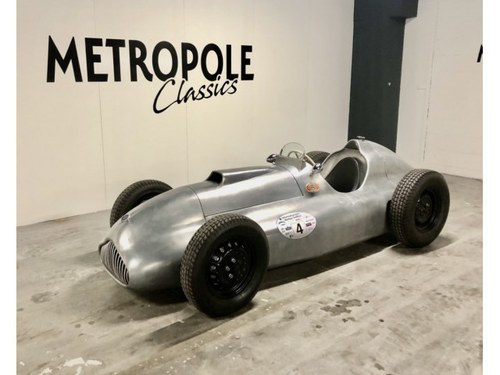

Description
In 1949, under the designer Ernst Loof, the Veritas Meteor, a single-seater with free-standing wheels corresponding to the then valid Formula 2 , after 1952 and 1953, the races were held for the World Automobile Championship. Approved were racing cars with up to 500 cc and compressor or with a maximum of 2000 cc displacement without compressor.
The basis of Heinkel's engine in the Veritas Meteor was the six-cylinder engine of the BMW 328, which was further developed by former BMW employees Karl Schäfer, Karl Rech and Max Knoch. The eye-catching feature of the new inline engine with a displacement of 1988 cc was the overhead camshaft, which controlled the V-shaped hanging in the cylinder head valves. The crankshaft ran in lead-bronze bearings, while the connecting rods were roller-bearing both on the crank pin and on the piston pin. The engine made 140 hp at 7000 min; it was water-cooled with 10 liters of water in circulation and had dry sump lubrication with a capacity of 12 liters.
The power was transmitted via a single-disc dry clutch, a five-speed gearbox with a special oil pump and a cardan shaft to a self-locking differential gear or to the rear wheels. Depending on the racetrack, the gears of the differential could be changed to adjust the ratio.
The frame of the Veritas Meteor consisted of a pipe grid ( grid frame ). The front wheels were hung on double wishbones, with each a longitudinal torsion spring bar acted on the upper handlebars and the oblique telescopic shock absorbers were supported on the lower arms. The likewise torsstabfedered rear double-jointed axle had on each side of a wishbone and in addition a wishbone on the differential and from 1952 a De-Dion support tube behind the differential.
The foot brake worked hydraulically on four light metal drums via two brake cylinders. The car was driven either with steel disc wheels or with Rudge steel spoke wheels, both versions with central locks.


