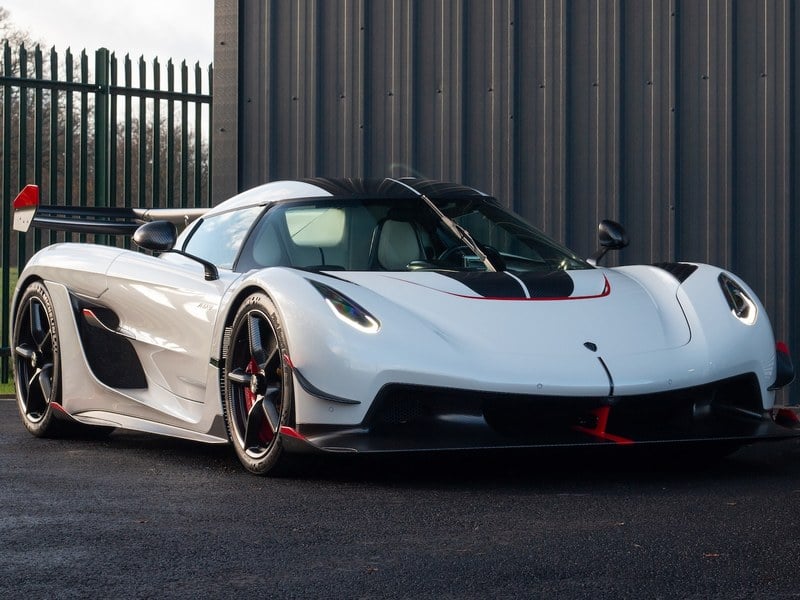

Description
LOT 255PN,?
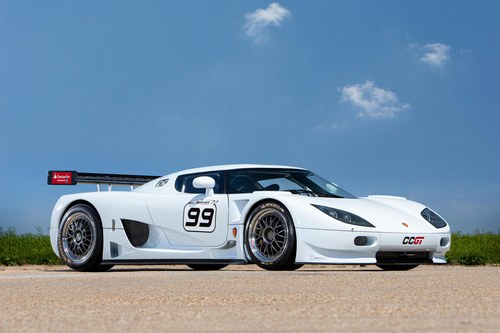
2007 Koenigsegg CCGT GT1 Competition Coupé
GOODWOOD FESTIVAL OF SPEED
14 July 2023, 14:00 BST
Chichester, Goodwood
£3, 000, 000 - £4, 000, 000
Chassis no. YT9M1GOV8 007012
• The only Koenigsegg CCGT built
• Only one private owner since it left the factory
• Kept in temperature controlled, dry and dark conditions
• Twice-yearly engine maintenance runs
• Practically new
Former holder of the Guinness World Record as builder of the fastest production car, the Swedish firm of Koenigsegg succeeded - against all the odds - in establishing itself in the front rank of supercar manufacturers within a decade of its foundation. Among UK motoring enthusiasts Koenigsegg is now a household name, thanks to its setting a new lap record on BBC Television's programme in 2006, ahead of all contemporary supercars.
The company was founded in 1994 by sports car enthusiast Christian von Koenigsegg, who was running a successful import/ export business at the time. His aim was nothing less than the creation of the ultimate performance car, where no technical solution would be deemed too difficult. Christian himself drew up the initial layout and in those days he even hand-modelled everything himself, together with a few friends who helped out for meagre wages. Nowadays, of course, the company has its own R&D department boasting state-of-the-art equipment, but in the beginning inspiration, enthusiasm and imagination had to suffice. Incredibly, the first prototype was completed in 1996, only two years after the project had commenced.
Rather like its cars, the Koenigsegg company moved at a record pace and in 2002 began series production of the CC8S model. The CC8S's arrival demonstrated that it was indeed possible for a passionate, dedicated young manufacturer to compete with the older, long-established supercar brands.
After a fire at its original premises, Koenigsegg relocated in 2003 to its present location and headquarters: a former fighter jet facility that had previously belonged to the Swedish Air Force. Along with the buildings came a 1. 7km runway, which turned out to be perfect for high-speed testing. Since the runway is 50 metres wide it can also serve as a test track. Many Koenigsegg customers have enjoyed landing their private jets just outside the factory gates, and there is also a heli-pad in front of the main entrance.
In the spring of 2004, and as a result of an intimate collaboration with Norwegian advanced design and engineering house Eker Design, Koenigsegg launched the CCR, a supercar that surpassed all others, breaking the Guinness World Record for the fastest production road car, which until then had been held by the McLaren F1. In 2006 a Koenigsegg CCX set fastest lap in the now famous programme, and then the following year Koenigsegg launched the CCXR: a 1, 018bhp version of the CCX capable of running on environmentally friendlier E85 fuel. This pioneering development made it the world's first 'green' supercar, but Koenigsegg was not done with record breaking yet, setting a new 0-300-0km/ h record of just 29 seconds with a CCX. Although built to excel on the racetrack, a Koenigsegg is nevertheless a comfortable means of high-speed long-distance travelling.
Launched at the Geneva Automobile Show in 2007, the CCGT was originally developed to participate in the 24 Hours of Le Mans series, in adherence with the then prevailing FIM regulations for LMP prototype cars. The Koenigsegg CCGT came about as a side project that was worked on when time was available from the engineering and building of the production cars. The CCGT was based on a Koenigsegg CCR with some elements from the CCX model, while the team made sure that the car would meet the regulations for one for the most interesting racing categories at the time: the GT1 Class. The regulations stated that the car was not allowed to be wider than 2 metres and that the cockpit had to be at least 70% of the width of the car. The result was one of the rarest and most exiting Koenigseggs ever made, and the sound of the engine is just amazing.
The CCGT weighed under 1, 000kg without ballast, generated over 600kg of downforce and had over 600bhp available from its normally aspirated 5. 0-litre 32-valve V8 engine, the maximum being restricted. Power reached the rear wheels via an AP-Racing twin-disc clutch and a Koenigsegg/ Cima sequential magnesium transaxle, while other specification highlights included double wishbone suspension; pushrod operated gas-hydraulic shock absorbers; pneumatic pit-stop lifting system; rack-and-pinion steering; and 362mm carbon disc brakes all round gripped by light alloy six-piston monobloc callipers. The carbon-fibre/ honeycomb chassis is topped by a two-seater carbon-fibre/ Kevlar body incorporating a homologated full roll cage by Koenigsegg-ME-Racing. A conventional gear lever was fitted originally, but now the sequential gearbox is operated by paddle shifts mounted on the steering wheel.
Under the careful supervision of Dag Bölenius, the car was developed and hand-built by a specialist team between 2003 and 2007 before a series of test drives was conducted at Knutstorp race circuit in 2008 with legendary test driver and supercar engineer Loris Bicocchi behind the wheel. But only two months after Koenigsegg started the first shake-down runs, the ACO and FIA changed regulations for the GT1 class. Carbon monocoques were no longer allowed and minimum production numbers went from a total of 20 cars over several years to 350 cars per year. That ended the dream of racing in the GT1 Class after only one CCGT had been completed, thus guaranteeing the uniqueness of this exceptional race car.
Following the end of Koenigsegg's GT1 racing ambitions, the CCGT was acquired by the then largest shareholder in Koenigsegg Automotive, former Offshore Class 1 World Champion and owner of Eker Design and high performance boat manufacturer Hydrolift, Mr Bård Eker., and has remained in his ownership ever since. Aside from the occasional displays and demonstration runs, the car has been in storage in temperature controlled, dry and dark conditions, subject only to twice-yearly engine maintenance runs. Thus the car is practically new, and still sits on the same slicks it was originally fitted with. The Masters Historic Racing organisation have confirmed to Bonhams that although the car did not in fact race in period, it was built to the as then GT1 regulations and therefore they would be delighted to accept it on that basis to race in the Masters Endurance Legends Series.
Please note that this vehicle is from outside the UK. Our customs agents, CARS UK will manage all post sale customs administration. A fee of £350+VAT will be charged on the buyer's invoice to administer both import or export customs movements. If the buyer also chooses to ship with CARS UK, this will be quoted separately. If this vehicle is to stay in the UK, it will be subject to Import VAT at the standard rate of 20% and Import Duty at 10%+VAT on the hammer price. This vehicle will not be available for immediate collection after the sale and will only be released on completion of customs clearance. If you have any questions regarding customs clearance, please contact the Bonhams Motorcar Department.
Purple Paddle Lot: Please note there is restricted bidding on this lot which requires enhanced bid verification checks. Please contact us at using the button below or call +44 20 7447 7447 as soon as possible if you are planning to bid on this lot to prevent any last-minute delays.
Buyers' Obligations
ALL BIDDERS MUST AGREE THAT THEY HAVE READ AND UNDERSTOOD BONHAMS' CONDITIONS OF SALE AND AGREE TO BE BOUND BY THEM, AND AGREE TO PAY THE BUYER'S PREMIUM AND ANY OTHER CHARGES MENTIONED IN THE NOTICE TO BIDDERS. THIS AFFECTS THE BIDDERS LEGAL RIGHTS.
If you have any complaints or questions about the Conditions of Sale, please contact your nearest customer services team.
Buyers' Premium and Charges
Like the vast majority of auctioneers Bonhams charge a Buyer's Premium on the Hammer Price of each Lot purchased and this is subject to VAT. Some lots may also be subject to VAT on the Hammer Price and these lots will be clearly marked with a symbol ( †, ?, *) printed beside the lot number.
For Automobilia the Buyer's Premium is 28% on the first £40, 000 of the hammer price; 27% of the hammer price of amounts in excess of £40, 001 up to and including £800, 000; 21% of the hammer price of amounts in excess of £800, 001 up to and including £4, 500, 000 and 14. 5% of the hammer price of any amounts in excess of £4, 500, 001. (subject to VAT)
For Motor Cars and Vehicle Registration Numbers the Buyer's Premium will be 15% on the first £500, 000 of the Hammer Price of each Lot, and 12% on the balance thereafter.
VAT at the standard rate is payable on the Buyers Premium by all Buyers, unless otherwise stated.
Payment Notices
For payment information please refer to the sale catalog.
Shipping Notices
For information and estimates on domestic and international shipping as well as export licences please contact Bonhams Shipping Department.