
Beschreibung
This is Lot 364 in the Bonhams Spring Stafford Sale on April 20 & 21, please see the Bonhams website for full details.
The 14th production Black Lightning produced
One of two delivered new to Poland
Ordered for sidecar racing
Raced successfully in Poland by Tomasz Kamiński
Brought back to the UK in 1972
Present ownership since 1976
Professionally restored circa 1999/ 2000 and unused since
'Barn find' condition for recommissioning/ restoration
At a time when almost all major motorcycle manufacturers offer 1, 000cc superbikes of broadly similar performance, it is hard to imagine the status enjoyed by the big Vincent v-twin in its 1940/ 50s heyday. This was a time when the average family saloon was barely capable of reaching 70mph, and not until the arrival of Jaguar's XK120 was there a production sports car that could live with the thundering v-twins from Stevenage. With a top speed approaching 120mph and bettering it in the Black Shadow's case, the Vincent v-twin was quite simply the fastest production road vehicle of its day.
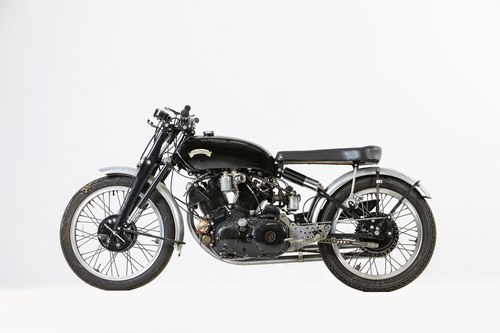
At the pinnacle of Vincent production sat the Black Lightning: a competition model produced in limited numbers and affordable only by enthusiasts with the deepest of pockets. It is also notable as one of very few motorcycles immortalised in song: by folk/ rock hero Richard Thompson (Vincent Black Lightning). It was Rollie Free's capture of the 'world's fastest production motorcycle' record in 1948 on a tuned Series-B Black Shadow that led directly to Vincent marketing a racer of similar specification to Free's machine: the Black Lightning.
His motorcycles' design innovation and engineering excellence notwithstanding, Philip Vincent well understood that it was performance that grabbed the headlines and stimulated sales. Season-long racing was prohibitively expensive but a one-off speed record attempt was more affordable, and the latter was the obvious choice for cash-strapped Vincent, all the more so because it was already producing the world's fastest production vehicle (both two and four wheeled): the Black Shadow.
The most famous and spectacular Vincent record attempt is that undertaken by Free, who rode multi-millionaire oilman John Edgar's special factory-prepared Black Shadow to a speed of over 150mph on the Bonneville salt flats in Utah in 1948, the first time that an un-supercharged motorcycle had surpassed that figure. The photograph of Free, lying prone on the Vincent wearing only swimming trunks and running shoes, is one of motorcycling's most reproduced images.
To enable Free to reach 150mph, the power of the Shadow engine ('1B/ 900') had been boosted from 55 to around 70bhp by means of - amongst other things - a raised compression ratio, Mark II (Lightning) cams, Amal TT carburettors, and 2"-diameter, straight-through exhaust pipes, all of which found their way on to the production Black Lightning. First exhibited at the 1948 Earls Court Show, the Lightning came equipped for racing with rev counter, alloy wheel rims, Elektron (magnesium alloy) brake plates, and a gearbox modified for quicker changes. For many years it had been assumed that around 20 examples of this, the ultimate Vincent v-twin, had been built between 1948 and the end of production in 1955, though more recent research has established that the total was 34 (one with a Series D engine), while a further half-dozen-or-so engines were supplied for use in racing cars.
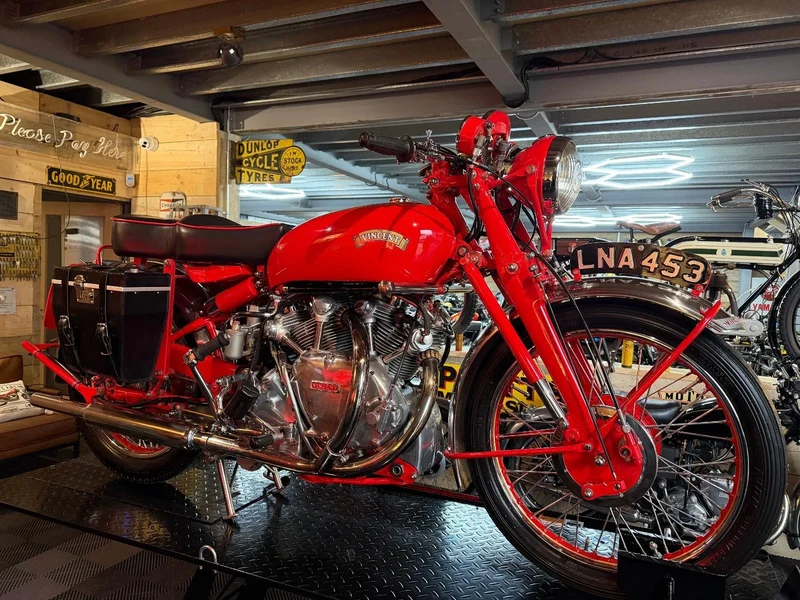
This Vincent Black Lightning is one of a pair (the other being '4652/ 2752') despatched to Poland towards the end of 1949. Factory records show '4652/ 2752' being delivered on 15th November 1949 and this machine exactly 14 days later. This was a time when the ruling communist authorities in the Eastern Bloc states controlled almost every aspect of daily life; private citizens were not allowed to import goods for their own consumption - much less complete motorcycles - so the brace of Vincents was ordered by the Centrala Handlowa Przemyslu Motoryzacyjnego Motozbyt (Commercial Headquarters of the Automotive Industry Motozbyt or CHPM for short). The 13th and 14th production Black Lightnings produced, the two CHPM machines were intended for sidecar racing; the one offered here is the 14th, CHPM No. 2.
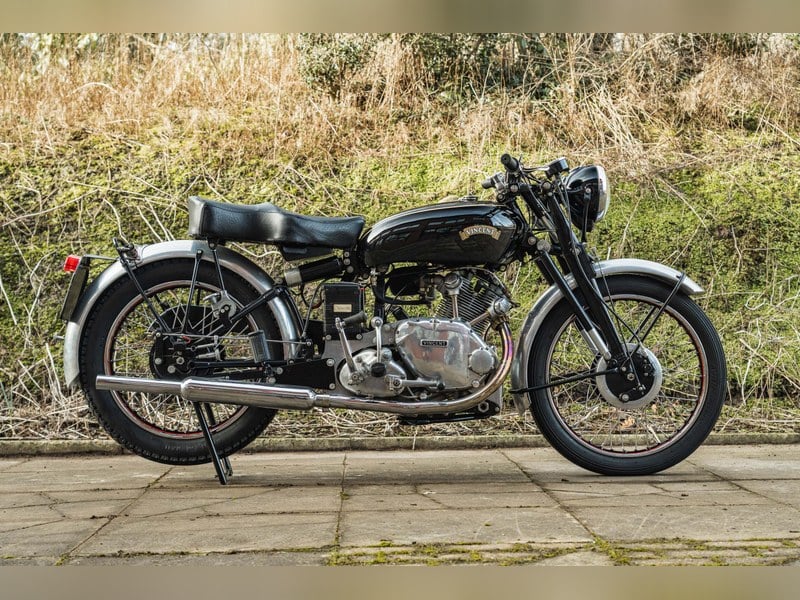
The accompanying photocopy Works Order Form shows that this machine was built with Girdraulic forks; Amal TT10 racing carburettors; 280km/ h speedometer; straight-through exhaust; racing mudguards; 52T and 56T sidecar-gearing rear sprockets; and a Lucas KVFTT magneto, and was delivered without lights or a horn. The Black Lightning was tested by 'CJW', believed to be Works Manager Jack Williams, father of Peter. Engine builder Denis Minett's famous notebook records that the Black Lightning also had sidecar mounting brackets and sidecar springs fitted (see extract on file).
Fast forward 20-plus years and we find Vincent Owners' Club member Ian Harper touring the Eastern Bloc in 1971 on his 'Green Meanie' special. While in Warsaw, Ian met two motorcycle enthusiasts, Andrzej and Woyciech Echilczuk, who told him that they knew of a Vincent somewhere in the city. It turned out to be one of the 'Polish Lightnings' (that offered here) and little more than a year later the brothers had tracked down the second ('4652/ 2752'). Ian ended up making two separate trips to bring the Black Lightnings back to the UK. The two Vincents were brought back dismantled, this one having been classed as 'scrap' by the engineer charged with issuing the necessary export paperwork (copy on file), while a little subterfuge was employed to bring '4652/ 2752' safely back home. It should be noted that this report (dated 19th August 1972) records the frame number as 'RC5130', not 'RC5130C' as it is now. The full story of the retrieval of the Polish Lightnings was published in MPH (January and February 2012 editions) and also in The Classic MotorCycle magazine (February 2018). Copies of both articles are on file.
According to the Echilczuk brothers, this Black Lightning had been raced with considerable success by Tomasz Kamiński between 1950 and 1954 when it was taken over by one Branecki. The Vincent was later sold and raced by the privateer Nowacki, passing to someone called Trzcinski before being acquired for Ian Harper by Andrzej Echilczuk from someone called Ankiewicz.
Back in the UK, Ian Harper did little to the two Lightnings before selling both to former Vincent factory tester and racer Ted Davis, later the company's Chief Development Engineer. Writing in MPH (December 1982 edition) Davis recalled: "I actually road tested these two when they were first built and could remember the odd specification: steel rims, touring footrests, wide bars, etc."
Its late owner acquired this Black Lightning from Ted Davis circa 1976. (The other Polish Lightning, '4652/ 2752', is now in The National Motorcycle Museum.) Correspondence on file shows that marque specialist Bob Culver restored this machine for its late owner circa 1999/ 2000. We are advised by the VOC Machine Registrar Simon Dinsdale that the headstock fitted presently is of the early type (not the later design that this example would have left the factory with), which has been stamped with the number 'RC5130C' (please note the works record records 'RC5130'). It is not known when this substitution was carried out, although presumably after the Vincent left Poland (see above).
Following the restoration's completion, the Black Lightning was placed in dry storage where it has remained for the last 20-plus years. Presented in 'barn find' condition, the machine will require recommissioning at the very least and possibly more extensive restoration before further use and thus is sold strictly as viewed. As with all Lots in the sale, prospective purchasers must satisfy themselves with regard to this motorcycle's authenticity, completeness and correctness prior to bidding. The accompanying history file contains all the aforementioned documentation and a small quantity of spares is included in the sale.
With only some 34 complete machines produced, the Black Lightning is unquestionably the most collectible Vincent ever. All the survivors are either in museums or the hands of private collectors, and only very rarely is one sold publicly, which makes the sale of this 'Polish Lightning' an event of exceptional importance.