Description
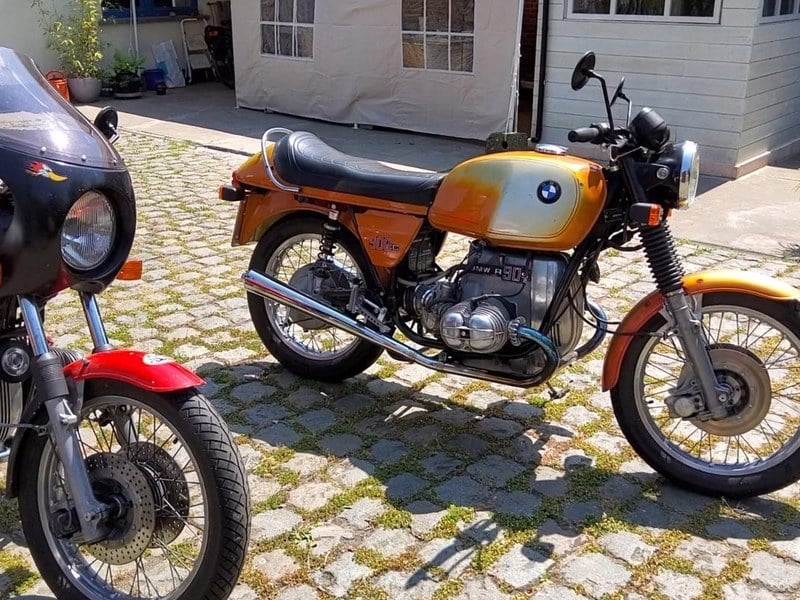
Immaculate BMW R90/ S 1975
Fully serviced
UK Registered
WINTER 2025 PRICE REDUCTION
Great classic investment - very usable motorcycle
This is a fabulous example of one of the original superbikes. Shaft drive, complete with fairing and clock it is a great investment and a bike that can be ridden in 2024 with total confidence. The overall condition is exceptional.
Some local history (hand written) and magazine articles
The BMW R90S was one of the first superbikes, shaft drive, faired complete with a clock it is a truly superb motorcycle. This is one of the best we have seen, imported from the USA and supplied fully serviced with a new MOT this is truly a very good motorcycle and a superb investment.
BMW R90/ S
Model history
The BMW R90S is a 900cc sport motorcycle produced by BMW from 1973 to 1976. BMW commissioned designer Hans Muth to oversee the R90S, which became the flagship of the boxer engine "/ 6" range. Sporting distinctive two-tone paintwork, a bikini fairing and a new tail, the R90S was intended to shrug off the enduring image of BMW bikes as staid and utilitarian.
The 67 bhp (50 kW) R90S had a top speed of 124 mph (200 km/ h), it ran the quarter mile in around 13. 5 seconds and it accelerated from 0 to 62 mph (0–100 km/ h) in 4. 8 seconds. Maximum torque was delivered at 5, 500 rpm and the engine redlined at 7, 200 rpm.
The R90S' "airhead" engine was a pushrod OHV, two valves per "boxer" unit. The engine was based closely on the R75/ 5 sharing the same stroke, but with a larger bore, to give a capacity of 898cc. The R90S weighed 215 kg (474 lb) and has a five-speed gearbox with a shaft drive. The first R90S models had a two-tone paintwork scheme of "Smoke Black/ Silver" with adhesive gold pinstripes. Feedback from unimpressed customers prompted BMW to return to hand painted pinstripes. Later R90S models were available also in two-tone "Daytona Orange" with red pinstriping. The R90S had a redesigned seat, with a small "ducktail" fairing which (in addition to an underseat tool tray) provided a small storage space lightweight items such as waterproofs. Standard equipment included a full toolkit, a hand pump, a first-aid kit and even a small hand towel with an embroidered BMW logo.
The R90S had a small bikini fairing which housed two analogue instruments: a clock and a voltmeter. An adjustable hydraulic damper was manually adjusted via a knob on the steering head. Suspension was by long-travel telescopic forks and twin rear shocks whose rear dampers were adjustable for preload (the only suspension adjustment available). Whereas other BMW boxers had Bing slide constant velocity carb the R90S was fitted with accelerator pump carburettors. The R90S engine had a 9. 5:1 compression ratio, while the less sporty R90/ 6 had a ratio of 9:1.
The alloy wheels were spoked and wore tubed tyres. The front brake had twin 230 mm disks and ATE callipers; the rear brake was a 200 mm drum. The R90S and the other BMW "/ 6" series front brakes had an unusual system whereby a master cylinder on the top frame tube was activated by a cable from the front brake lever. This arrangement was supposed to protect the master cylinder in the event of a crash; but later machines adopted a conventional handlebar -mounted Brembo master cylinder.
There were three series of the R90S:
· model year 1974: September 1973 to August 1974 (6, 058 units)
· model year 1975: June 1974 to September 1975 (6, 413 units) - A strengthened crankshaft has a new main bearing to prevent flex.
· model year 1976: August 1975 to June 1976 (4, 984 units) - Engine casings are improved in anticipation of the forthcoming R100S.
Other differences distinguish the three series: After the first series, brake discs were drilled. The first series kept the "/ 5" series kick start lever. The later 17mm diameter front axle was stronger than the first series 14mm axle. The original R90S had "/ 5" switchgear, but this was changed in 1975 to a new non-standard design that proved unpopular. The engine crankcase breather was a phenolic disc-&-spring item which made a 'popping' sound as the breather operated. The modified "/ 7" breather was a reed valve design, which could be retro-fitted to "/ 6" models to replace their noisy breathers.