Descrição
This car is Lot 127 to be auctioned by Bonhams|Cars at The Bonmont Sale on 29 June, please see the Bonhams website for full details.
Public Viewing:
Available Friday 27 June from 13:00 until 19:00, Saturday 28 June from 10:00 until 18:00 and Sunday 29 June from 10:00, at The Golf & Country Club de Bonmont.
Lot 127
2021 Ford GT Carbon Series Coupé
Registration no.
Chassis no. 2FAGP9DW4LH100251
Modern reworking of an iconic racing GT
'Second generation' V6 turbo model
Delivered new in Switzerland
Serviced prior to sale
All books, tools and accessories
"This is what true innovation looks like. From its 3. 5L EcoBoost® technology to its ultra-efficient aerodynamics, the Ford GT is the culmination of everything great we do at Ford. ... everything about the Ford GT is designed to deliver pure performance." - Ford Motor Company.
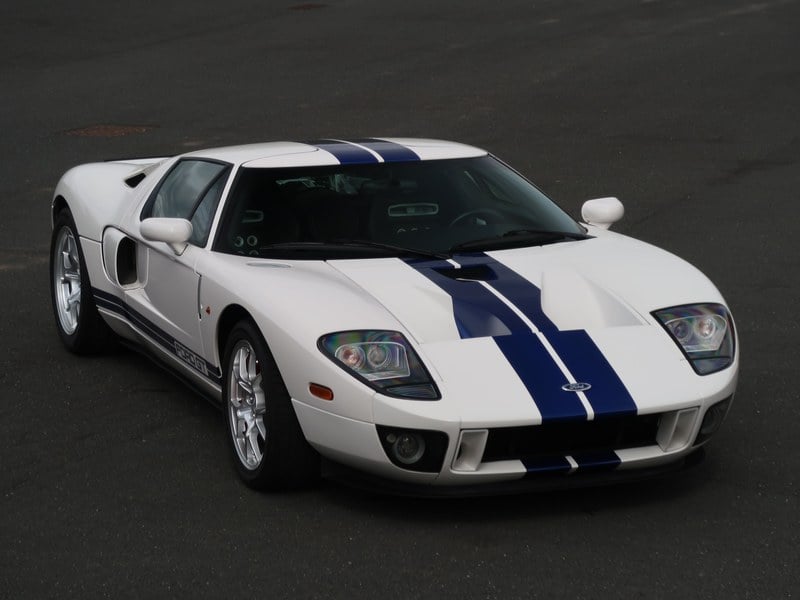
Based on Eric Broadley's Lola GT, the original Ford GT40 was spawned by the Dearborn giant's ambition to beat Ferrari at Le Mans, a feat it duly achieved for the first time in 1966. The GT40 project had commenced three years previously, following Ford's failed attempt to buy into Ferrari, and was based at the Ford Advanced Vehicles plant at Slough, England. The GT40 first ran competitively in 1964 but failed at Le Mans that year and again in 1965. That first sweet Le Mans victory would fall to the 7. 0-litre Mark II, with victory the following year going to a US-built Mark IV 'J' car. (The GT40 Mark III was the British-built road-going version). Of the three GT40s that lined up together for that famous 1-2-3 clean-sweep finish at Le Mans in 1966, the first two were entered by Shelby American while the third, driven by Ronnie Bucknam and Dick Hutcherson, was entered by Holman & Moody.
A decade later and the GT40's status as an all-time great classic sports car had been firmly established, leading to an increased demand for unmolested originals and the start of a replica-building industry. Perhaps the only surprise concerning the emergence of a reconstituted 'official' version is that it took Ford the best part of 40 years to get around to it.
The 'new generation' GT was developed by Ford's Special Vehicle Team Engineering department under the direction of John Coletti and Fred Goodnow. The composite body panels were unstressed, as on the original, but instead of the monocoque chassis construction used in the 1960s, SVT Engineering developed an all-new aluminium spaceframe combining extruded sections and panels. Doubling as fuel reservoirs, a pair of massive sills contributed much to the original's chassis stiffness, whereas the new GT relied on a centre-tunnel 'backbone' that greatly improved ease of entry and exit. The suspension design was an advance on the original's, consisting of unequal-length control arms and a pushrod/ bell-crank system acting on horizontally mounted coil spring/ damper units. Braking was handled by six-piston, Alcon callipers with cross-drilled and ventilated discs all round.
In defeating Ferrari's more highly stressed V12s, Ford proved that the traditional American V8 possessed all that was necessary to compete at the cutting edge of international endurance racing. A far cry from the simple pushrod units of the 1960s, the supercharged MOD 5. 4-litre V8 produced 550bhp at 5, 250rpm and 500lb/ ft of torque at 3, 250 revs; figures on a par with those of the 7. 0-litre engine that won at Le Mans in 1966 and 1967. The all-synchromesh six-speed transaxle used ZF internals and was sourced from RBT Transmissions, whose founder Roy Butfoy had been a member of Ford's racing team at Le Mans. The interior featured leather-upholstered, Recaro bucket seats with aluminium ventilation grommets embedded into the panels. The instrument layout followed the original's, comprising analogue gauges and a large tachometer complemented by modern versions of the traditional toggle switches.
Back in 1966, the Ford GT40 endurance racer became the first car to exceed 200mph along the Mulsanne straight at Le Mans. Matching that would be some achievement for the production road car, even allowing for nearly 40 years of technological progress. Tested for Motor Trend magazine by Indycar racing legend Bryan Herta, the new Ford GT duly topped 200mph at Ford's Kingman test facility in Arizona, emphatically demonstrating that it was indeed worthy of that famous name. A total of 4, 038 cars had been completed when production ceased at the end of 2006, over three quarters of which were delivered in the USA.
In 2015 a second-generation Ford GT was unveiled at the North American International Auto Show. Technologically a far cry from its predecessors, the new Ford GT featured a 3. 5-litre twin-turbocharged V6 engine; a carbon-fibre monocoque chassis; carbon-fibre body panels; pushrod suspension; and active aerodynamics. Producing 647bhp, the EcoBoost turbo V6 drove the rear wheels via a Getrag seven-speed DCT gearbox. The factory claims a sub-3. 0 second 0-60mph time and a top speed of 216mph (347km/ h), which makes the Brembo carbon-ceramic brakes a necessity rather than a luxury.
In fact, Ford's new supercar had been created with GT racing in mind, hence the presence of an integral roll cage and a host of other competition-car technologies. Yet despite its start-of-the-art track-focused suspension, the GT has a ride quality rivalling that of a luxury saloon. Autocar's Matt Prior was obviously impressed: "the GT... has a level of composure - that balance between ride and handling that I'm not sure I've better experienced in 20 years of road testing. It's so compliant, yet there's so little roll, and body movements are so well controlled, that is genuinely astonishing". All of the planned 1, 000 road models had been sold before deliveries commenced in 2017, and these exclusive supercars remain highly sought after today.
And as for its maker's racing aspirations, the new GT did not disappoint. At Le Mans on 19th June 2016, the number '68' Ford GT of Ford Chip Ganassi Racing driven by Hand/ Müller/ Bourdais finished 1st in the LM GTE-Pro class, their victory marking 50 years after Ford's first Le Mans win in 1966 with the original GT40.
In 2018 Ford announced a new limited edition model: the Carbon Series, which was positioned in the range midway between the regular GT and the Competition Series. As its name suggests, the Carbon Series made much more extensive use of this lightweight material than the GT, while the adoption of a titanium exhaust and carbon-fibre wheels helped reduce the weight by 18kg. Air conditioning and an infotainment system were retained (unlike in the US-only Competition Series) while other notable special features included anodised paddle shifters and silver stitching on the seats and steering wheel. The GT's engine was retained unchanged.
Ford updated the GT for the 2020 model year, introducing several mechanical upgrades and new special editions. The 3. 5-litre blown V6 now incorporated gallery-cooled pistons, higher-energy ignition coils and larger intercoolers, and produced 651bhp while at the same time delivering a 'broader torque band' according to Ford, although peak torque remained unaltered. Previously optional, the standard exhaust was now the lighter titanium system by Akrapovič, which still delivered the GT's evocative engine note. The suspension was now stiffer in Track mode, and the rear buttresses had been redesigned to increase airflow over the car. Production of the second-generation GT ceased in 2022.
Finished in Matt Black with matching interior, this one-owner, limited edition Ford GT Carbon Series has covered a mere 250 kilometres since it left the factory and is presented in commensurately 'as new' condition. The car was delivered new in Switzerland where it is currently resident and has scarcely been driven, covering only the minimal distance required to keep it in running order. It has only been used on public roads and has never been driven competitively. On account of this restricted use the car has only been serviced once: on 10th June 2025, to make it ready for sale.
Offered with all books, tools and accessories, and presented in stunning, 'as new' condition, this pristine Carbon Series example represents a not-to-be-missed opportunity to join the select band of Ford GT owners.
All lots are sold 'as is/ where is' and Bidders must satisfy themselves as to the provenance, condition, age, completeness and originality prior to bidding. Visit the Bonhams|Cars website for all pertinent auction information.