Beschreibung
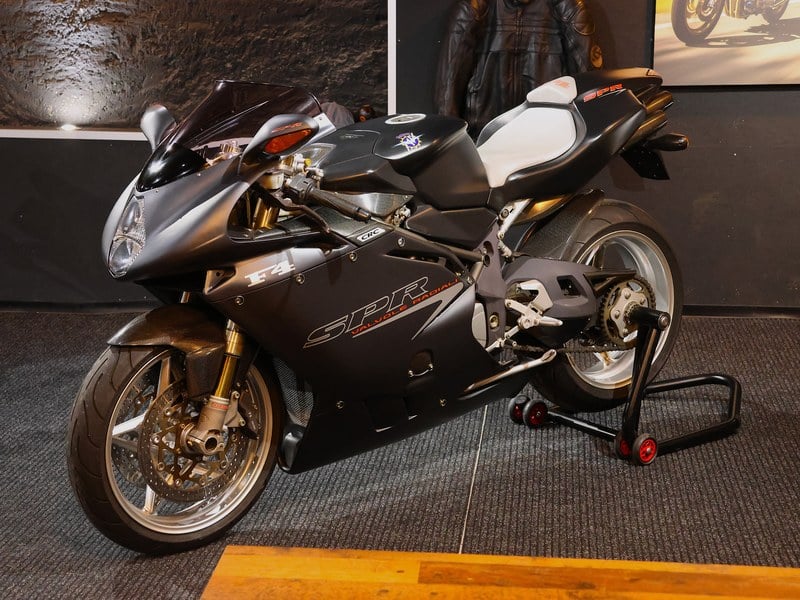
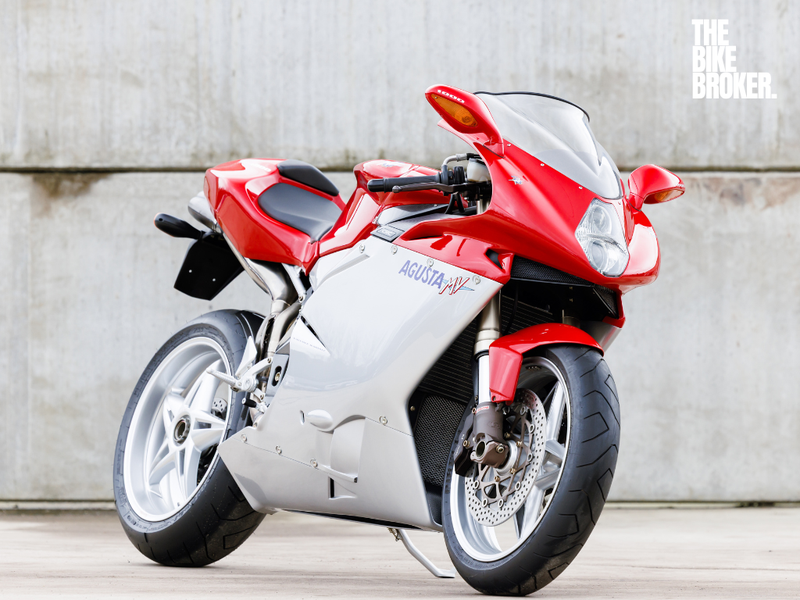
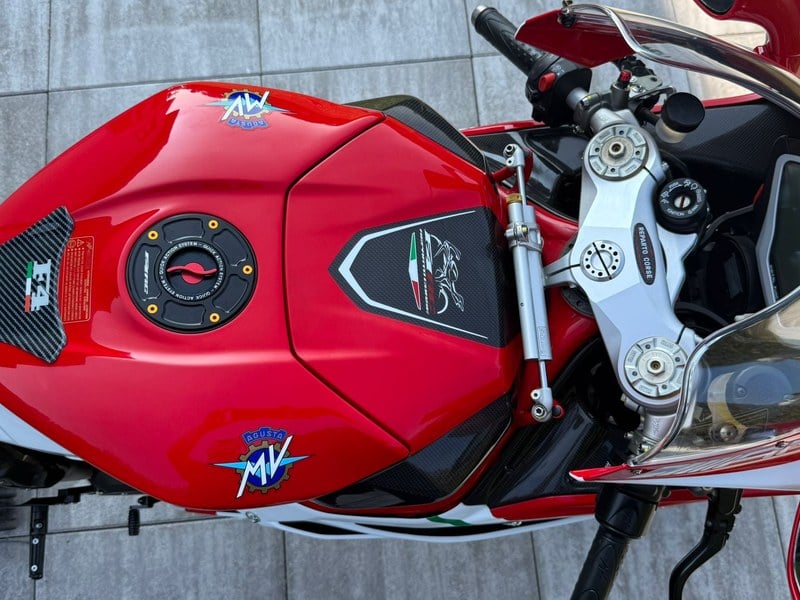
The bike was designed by Adrian Morton and the engine designed by Ezio Mascheroni. It was first shown at the EICMA motorcycle show in Milan on 2 November 2010, and incorporates the lines of the MV Agusta F4, with the diamond headlamp, tapered seat shell and single-sided swinging arm offering a view of the rear rim. Unlike the F4, the exhausts are not positioned under the seat but open on the right side of the bike, just in front of the rear wheel.
The limited edition Oro (Gold) version went on sale in December 2011 and the standard model in January 2012.[8] Since 2013, the F3 has been offered with two different engine sizes: 675 and 800 cc.
The F3 was developed in conjunction with the Brutale 3 cylinder, ushering in a new chassis and new engine, giving the brand a new lease of life on the commercial front. The engine of the F3 serves as the basis for the entire 3-cylinder range of the manufacturer: the Rivale, Stradale and Turismo Veloce "hypermotard" models. The 675 cc engine uses a three-cylinder layout, which has given many world titles to the Varese company, but has been enriched by modern technology, such as multi-map wire guidance, to optimise engine performance based on needs and rider's preferences and controlled through simple settings.
A counter-rotating (reverse) crankshaft is used, which had previously only been used on MotoGP motorcycles, such as the Yamaha YZR-M1,[9] which counteracts the centripetal forces of the wheels allowing the bike to turn faster. The bore and stroke are 79 mm and 45. 9 mm, which is an extremely short-stroke. In conjunction with titanium valves, this allows an extremely high speed engine speed. The engine develops 126 bhp at 14, 400 rpm. Motor control is handled by the MV Agusta MVICS system, which includes ride-by-wire motor control. This includes four pre-set and one individually adjustable rider's setting (similar to the BMW system) as well as an adjustable traction control with eight levels.
The MV Agusta's usual short wheelbase, steep steering head angle (66°) and resulting short trail (99 mm), gives the machine gives very good handling combined with high stability. The steel tubular lattice frame with aluminum swinging arm support is relatively short and the single-sided swinging arm relatively long. The 43 mm Marzocchi upside-down forks are, like the rear Sachs shock absorber, are fully adjustable, as usual in this class. The cassette gearbox can be fitted with an automatic switchgear (MV Agusta EAS) for a surcharge.
Braking is provided by Brembo, with two 320 mm diameter discs at the front, with radial-mounted four-piston calipers, and a 220 mm diameter disc and a double-piston caliper at the rear. The wheels are made of aluminium.
An 800 cc version was introduced in 2013. To obtain the extra displacement the stroke was increased from 45. 9 mm to 54. 3 mm. The 800 develops 148 bhp at 13, 000 rpm.
In 2021 the 800cc was revised to meet the Euro 5 emission standard. Friction within the engine was reduced which, along with other changes, allowed the engine to still produce 147 bhp (110 kW). The Rosso was the first model to use the engine, followed soon after by the F3 RR.
F3 800 AGO
In 2014 a special version, the F3 800 AGO was introduced. It was dedicated to the former MV multiple world champion Giacomo Agostini. Production was limited to 300 units. It was equipped with lightweight components made of magnesium and carbon, bringing the weight down to 171 kg. The electronic management of the bike was integrated with the MVICS system (Motor & Vehicle Integrated Control System). The bikes were finished in red, white and green (Italian tricolor colours) and autographed by Agostini.