
Descripción
This car is Lot 109 to be auctioned by Bonhams|Cars at the Goodwood Festival of Speed Sale on 11 July, please see the Bonhams website for full details.
Public Viewing:
Available Thursday 10 July from 09:00 until 17:00 and Friday 11 July from 09:00 until 17:00, at The Goodwood Festival of Speed.
Lot 109
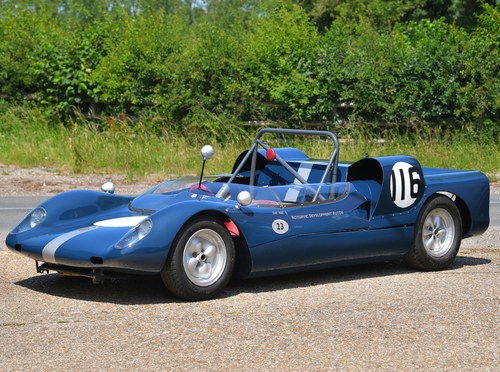
1965 Lotus-Rotorvic 23B 1. 5-litre V12-Engined Sports-Racing Prototype
Registration no.
Chassis no. RDA - 1
Unique V12 engined racer
Six Ariel Arrow engines combined to form a 12-cylinder two stroke engine
Previously displayed at the Donington Grand Prix Collection
Raced at the Goodwood Revival
Subject of a long term rebuild by Setford and Company
We at Bonhams Cars are particularly delighted to offer here one of the most spectacularly specified 1 ½-litre British sports-racing cars ever to have been conceived and produced during the core classic and Historic era of the mid-1960s.
This incredible one-off Rotorvic, which combines the chassis/ body structure of the super-competitive Lotus 23B with a unique 1, 482cc Ariel Arrow-based air-cooled V12-cylinder two-stroke engine, attracted considerable attention upon its debut in 1965.
That February saw John Bolster - the famously deer-stalker wearing, moustachioed pre-war racer/ hill-climber and postwar ERA driver who had co-founded 'Autosport' magazine - report in it: "This car designed by R. V. Marchant and driven by Bill Hill has a Lotus 23 sports-racing chassis, modified to take the unusual engine...(comprising) no fewer than six Ariel Arrow (parallel-twin) engines making in effect a 12-cylinder two-stroke engine of 1482cc. The air-cooled power units (each with its own Amal carburettor) are inclined outwards at 45 deg, giving an angle between the cylinders of 90 degrees. Each engine has a straight-toothed pinion on its mainshaft which engages with a similar pinion on a shaft which runs down the centre of the engine.
"These gears are enclosed in housings and the shaft has a flywheel on its end, which carries the single dry-plate clutch and drives the ignition system by toothed belts. The transmission is via a Hewland five-speed gearbox.
"Lubricated on the petroil system, the engines are at present cooled by air collected in large scoops. The car is in its early stages of development but already shows promise. The exhausts are arranged to collect three cylinders apiece into four separate megaphones, and the shape of these ducts will be the subject of elaborate experiments. Though eventually 10, 000 rpm will be exceeded, at present the machinery does its best work at 7, 500 rpm. Seen in action at Snetterton, the Rotorvic travelled at a good speed and made a splendid sound..."!
The project had been conceived by senior Lotus engine specialist R. V. 'Ron' Marchant as an experimental Formula 1 unit with greater power potential than the team's contemporary 1 ½-litre Coventry Climax V8s. However, when the FIA announced its new 3-litre F1 rules for 1966, Lotus chief Colin Chapman lost initial interest in this novel air-cooled V12 programme.
Ron Marchant continued work upon it as a private project, (helped by other Lotus employees "out of hours") at the premises of Bill Hill's Rotorvic Engineering company, based in Cuffley, Hertfordshire. The car was raced at Brands Hatch but apparently suffered an engine failure, evidence of which was found upon restoration strip-down 40 years later...
Ron Marchant preserved his unique engine, which his widow eventually donated to the Donington Grand Prix Collection Museum where it was displayed 1982-2006 before acquisition by the present vendor. Meanwhile the Lotus 23B chassis had been sold in 1968 via the Cheshunt Service Station racing car parts dealership to engineer Mike Rawlings, forming the basis of his Rawlson CR6 sports-racing design.
Remodelled with updated aerodynamic bodywork for 1970 as the Rawlson CR7 it was successfully campaigned by Gerry Marshall, then Mike Yeomans, before becoming a European hill-climb contender. The chassis returned from France in the 1980s, and passed in virtual Lotus 23B form and sold to the Utah Lotus Museum, USA. It was then acquired from the Museum in 2006 and when the current vendor learned it had been as-new the fabled Rotorvic-Lotus, contact was made with Kevin Wheatcroft of the Donington Grand Prix Collection who kindly released the power unit to be re-united with its original chassis.
The car was painstaking rebuilt by renowned historic Lotus specialist Peter Denty, before re-emerging in public at the 2008 Goodwood Festival of Speed. Further exhaust system development followed, with advice from two-stroke racing motor-cycle exhaust expert Professor Gordon Blair of Queens University Belfast.
This unique Rotorvic-Lotus then contested its first competitive race in over 50 years at the 2016 Goodwood Revival Meeting, anticipating more frequent use through 2017. However, a piston failure intruded, followed by a major long-term rebuild by respected specialists Setford & Company, during which the engine barrels and ports were re-designed, delivering an estimated 45 bhp per individual 'twin', so some 270 bhp overall.
The car is now considered "track ready" subject to normal further preparation and testing. As an accepted 'Goodwood' car it celebrates 1960s-style low-budget British innovation and ingenuity. It is in process of obtaining full FIA 'papers' with HTP number GB 9038 and we very much recommend it for the closest consideration. Not least it certainly generates about as much noise as the V16 BRM...
All lots are sold 'as is/ where is' and Bidders must satisfy themselves as to the provenance, condition, age, completeness and originality prior to bidding. Visit the Bonhams|Cars website for all pertinent auction information.