Beskrivning
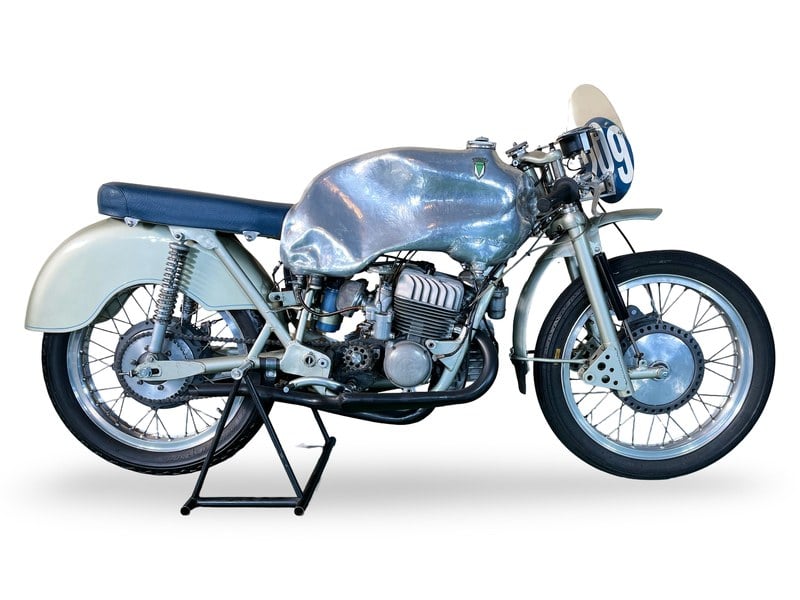
This motorcycle is Lot 69 to be auctioned by Bonhams at The Spring Stafford Sale (The International Classic MotorCycle Show) on April 25th & 26th, please see the Bonhams Motorcycles Website for full details. Auction Timings: Lots 1 - 94 are to be sold from 14:30 on Saturday 25th April 2026. Lots 201 - 353 are to be sold from 11:30am on Sunday 26th April 2026. Public Viewing: Available 25th & 26th April 2026 from 09:00 until 17:00, at The Staffordshire County Showground (The International Classic MotorCycle Show). The Connoisseurs Collection, Part II, Ex-works ** c. 1954 DKW RM350 Dreizylinder Racing Motorcycle** Registration no. not registered Frame no. 01054 Engine no. 5503 ** The Lot is from outside the UK. Shippio Ltd must automatically uplift this Lot after the auction, complete all post sale import or export customs administration, and store this Lot until it is customs cleared. A compulsory fee of £350 + VAT will be added to the buyer's invoice for this. This Lot cannot be collected from the auction venue by the purchaser or any alternative transporter. If the Lot is to stay in the UK or is not exported within 90 days of sale, Import VAT at 5% on the hammer price is payable.** DKW was founded in Zschopau, Germany in 1919 by Danish engineer Jorgen Rasmussen and built its first motorcycle power unit, a single-cylinder, clip-on engine for bicycle attachment, in 1921. Designed by Hugo Ruppe, this 122cc motor was a two-stroke, and DKW would remain faithful to this engine type from then on, becoming world leaders in two-stroke design in the 1930s thanks to the prescient adoption of the Schnuerle loop-scavenge system. The latter used flat-topped pistons rather than the then-conventional deflector-crown type, relying on carefully angled transfer ports to direct the incoming charge around the cylinder. In 1925 DKW embarked on a racing programme using 175cc and 250cc machines featuring the Bichrone system of supercharging using a 'slave' cylinder, significant success being achieved only after the 'split-single' cylinder configuration, which enabled better control of port timing, had been adopted. Ear-splittingly noisy, the supercharged split-single 'Deeks' eventually overcame reliability problems to become the dominant force in 250cc racing in the late 1930s, works rider Ewald Kluge making history in 1938 when he became the first German rider to win an Isle of Man TT race. Having relocated to the newly constituted West Germany after WW2, DKW resumed its competition programme in May 1948, fielding a racing version of its RT125 roadster at Hockenheim. The RT125 and DKW's supercharged pre-war machinery would remain 'top dogs' in domestic racing for the next couple of years before the firm was readmitted to international competition in 1950. By this time the FIM had banned superchargers, forcing DKW to respond with new naturally aspirated racers for the 125cc and 250cc classes. First seen in action in April 1951, the new '250' was an air-cooled parallel twin, the engine of which was carried in a tubular steel duplex-loop frame topped by an enormous hand-beaten aluminium alloy fuel tank. To overcome the handicap of the piston-port design's symmetrical port timing, a gear-driven rotary valve was incorporated into the rear of the crankcase. Power was boosted still further by the adoption of expansion chamber exhausts, one of the first uses of this technology. DKW's engineers had experimented with mounting the inlet valve and a separate Bosch magneto in front of the crankcase, replacing the earlier flywheel magneto, and then someone had the bright idea of putting a third cylinder in that location to create a '350' triple, the bore and stroke dimensions being reduced to bring capacity down to 348. 48cc. To quote the late Mick Walker: "In this way, one of the most innovative racing designs of the 1950s was born." The new triple went into the existing '250' chassis. Progress was slow but steady, with little to show for it in terms of results apart from Rudi Felgenheier's win in the '125' class at Solitude, DKW's first post-war Grand Prix victory. The arrival early in 1954 of engineer Robert Eberan von Eberhorst as head of the production and racing departments resulted in a major shake-up of the latter - the '250' being dropped and the '350' extensively redesigned by long-time DKW engineer, Helmut Gorg. Even Gorg's redesign failed to bridge the performance gap to the all-conquering Moto Guzzis, prompting a return to the workshop for further experimentation. According to Mick Walker: "The result was a much-improved machine that not only produced over 40bhp, but also offered increased reliability and improved handling." One of the most striking features of this latest design were its larger and more powerful linked hydraulic brakes, two to each wheel. Riding the revamped triple, August Hobl won the German National Championship's '350' class in 1955 and finished 3rd in the World Championship, and the stage seemed set for even...