Description
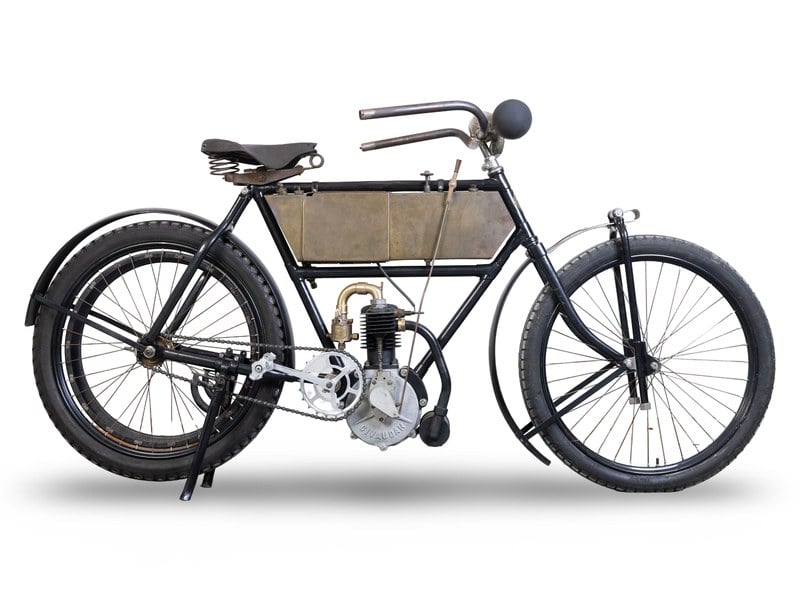
This motorcycle is Lot 216 to be auctioned by Bonhams at The Spring Stafford Sale (The International Classic MotorCycle Show) on April 25th & 26th, please see the Bonhams Motorcycles Website for full details. Auction Timings: Lots 1 - 94 are to be sold from 14:30 on Saturday 25th April 2026. Lots 201 - 353 are to be sold from 11:30am on Sunday 26th April 2026. Public Viewing: Available 25th & 26th April 2026 from 09:00 until 17:00, at The Staffordshire County Showground (The International Classic MotorCycle Show). The David Plant Collection ** 1903 Terrot 285cc Project** Registration no. not registered Frame no. 233 Engine no. not stamped The foreman of a French-owned textile machine factory based at Cannstatt, Germany, Charles Terrot left to go into partnership with merchant Wilhelm Stücklen in 1862, founding 'Stücklen & Terrot'. The firm made machinery for the textile industry and in 1887 opened a plant at Dijon in France. When this venture proved unsuccessful, Charles turned the factory over to making bicycles, which at that time were an increasingly popular novelty. Like many of his cycle industry contemporaries, Terrot turned to powered transport towards the end of the 19th Century and by the early 1900s the Dijon factory was making not only bicycles but also motorcycles, quadricycles and voiturettes. The name 'motocyclette' had already been registered by another company, so Terrot called his first motorcycles 'motorettes'. Proprietary engines supplied by Givaudan, Dufaux and Zédel were used for Terrot's early motorettes before the firm went on to develop its own. By the time war was declared in August 1914, there was a choice of two different models: a 2¾hp single (Motorette No. 3) and a 4½hp v-twin (Motorette No. 4), both of which used Zédel engines. Available as an extra-cost option, a combined clutch/ expandable pulley – mounted on the engine shaft – provided a means of variable gearing. Terrot began producing its own power units in the mid-1920s and by the decade's end had become France's largest manufacturer of motorcycles. The firm continued to offer a diverse range of machines in all sizes throughout the 1930s, garnering many competition successes along the way, but after WW2 concentrated mainly on lightweights. Terrot was taken over by erstwhile rivals Peugeot in 1961 and the once-famous name disappeared soon after. A most imposing Edwardian motorcycle, this early Terrot appears to be presented in largely complete condition, although there is no drive belt. The machine carries a Terrot plaque to the frame and has a period-style bulb horn. The machine is offered with a quantity of photocopied research material, together with correspondence with owners of similar early machines. An unfinished restoration project offered for completion, this motorcycle is identified by its frame number '233' and is accompanied by a letter from the Sunbeam Motor Cycle Club dating it to 1903, supporting its attribution as an early Terrot product. Further supporting correspondence on file from a recognised Terrot authority states that the earliest known surviving example at the time of writing was frame number '215', supplied new in December 1902 shortly after being exhibited at the Paris Motorcycle Show, with the next recorded machine being number '478'. The present machine, frame number '233', therefore falls squarely within this earliest known production sequence, strongly supporting its position as a very early example of the marque. Research material on file highlights the varied and evolving specification of Terrot motorcycles in the Pioneer period (circa 1902–1904), when the company employed a number of proprietary engines rather than a single standardised design. Alongside Zürcher & Lüthi (ZL) and other contemporary units, Givaudan engines are documented as a correct and period-used option, and were subsequently adopted more widely by the factory. Contemporary sources indicate that Terrot worked closely with Givaudan, with evidence suggesting that engines, or at least crankcases, were produced specifically for Terrot's use. Machines of this type typically featured automatic inlet valves and carburettors such as the Longuemare, consistent with early Pioneer-era engineering practice. Surviving documentation suggests that Terrot production at this time was extremely limited, with relatively small numbers produced and notable variation between individual machines, reflecting the experimental nature of early motorcycle manufacture. Accordingly, the specification of the present machine - including its Givaudan engine - should be viewed within the context of this formative low-volume phase of Terrot production, rather than against later standardised designs. Early Terrot motorcycles of this period are rare survivors, representing an important stage in the development of the French motorcycle industry. There are no documents with this Lot, which is sold strictly as viewed. The engine turns over. Following a period...