
Beschreibung
RhD
Located in the USA...
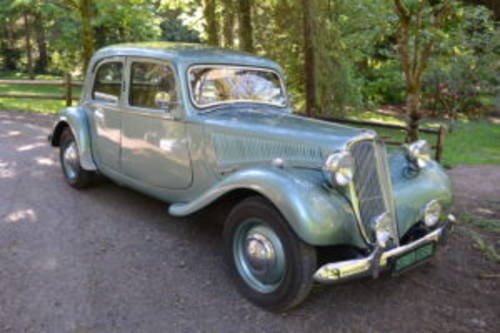
- A1955 Citroen Traction Avant 15 legere (light) RHD English Production.
- A Rare right hand drive Citroen Traction Avant with factory installed semiphore (trafficators) as required by Britain at the time.
-(French production was already using turn signals).
- A Wonderful original driver that was recently brought out of storage from an airplane hangar.
- Front wheel drive 4cylinder propels the charming 4 speed gearbox.
- Graceful running board-less art deco design invites top coats and formal gowns as you slide into the luxurious suicide doors up front or the massive lounge for a back seat with the style of French luxe.
- A Extraordinary road car that’s decades ahead of itself in road worthiness, economy and technology while still maintaining the illusion of prewar expression, design and style.
- These cars were eventually replaced by the ID/ DS series, another milestone car.
- The subject car is a driver needing nothing to enjoy.
- It is solid, roadworthy and delightful to the eye. A milestone to any automotive historian and a magnificent work of art to most.
- Henri Citroen was the Henry Ford of Europe.
- His lifetime opus may have been the “Traction” series. Traction Avant means “ Front wheel drive” loosely translated.
- Even in Greek this car is spectacular.
..............
Corrections to your description of the car.
The model is not rare. But the bigger version - a Big 15 is.
The car was made in the UK using some French components. As a car coming from the UK it is known as a Light 15. The number 15 reflects the theoretical power of the engine which , back in the day determined the road tax due.
The same car made in Paris (France) was known as a Legere meaning LIGHT , or 11BL meaning 11 (11 the theoretical horsepower according to the French formula ) and Berline means saloon.
Being English made it will have a 12v system not 6v like the French cars. leather seats wooden dash again not like the french equivalent that had fabric seats and painted steel dash. ETC...
Citroen's first name was ANDRE not Henri.
That air cleaner is not original and more SHARP photos will be required for a discerning buyer.
Gearbox would be better described as 3 forward gears and 1 reverse. To describe the gearbox as 4 speed is wrong unless, it has had a 4 speed gearbox fitted ?
The car does not maintain an "illusion of pre war style" - Period. It was designed in 1933 and the first models made in 1934. Therefore sir/ madam it is of the tail end of the art deco period.
...............
Specs and history.
- details above
The Citroën Traction Avant (French pronunciation: [tʁaksjɔ̃ aˈvɑ̃]) is an executive car produced by the French manufacturer Citroën from 1934 to 1957. About 760, 000 units were produced.
This Traction Avant pioneered mass production of three revolutionary features still in use today: a unitary body with no separate frame, four-wheel independent suspension, and front-wheel drive.
The Traction Avant, French for front-wheel drive, was designed by André Lefèbvre and Flaminio Bertoni in late 1933 / early 1934.
The Traction pioneered front-wheel drive on the European mass car market, along with DKW's 1930s models. Front-wheel drive had just appeared for the first time through luxury vehicle manufacturers Alvis, which built the 1928 FWD in the UK, and Cord, which produced the L29 from 1929 to 1932 in the United States.
The Traction Avant's structure was a welded unitary body / chassis. Most other cars of the era were based on a separate frame (chassis) onto which the non-structural body ("coachwork") was built. Unitary construction (also called Unit Body or "Unibody" in the US) results in a lighter vehicle, and is now used for virtually all car construction[2][3]
This unitary body saved 70 kg (150 lb) in steel per car. It was mass-produced, using innovative technology purchased from the American firm Budd Company. Weight reduction was a motivation for Citroën that American manufacturers of that time did not have. [4]
This method of construction was viewed with great suspicion in many quarters, with doubts about its strength. A type of crash test was conceived, taking the form of driving the car off a cliff, to illustrate its great inherent resilience.[5]
The novel design made the car very low-slung relative to its contemporaries – the Traction Avant was always distinctive, which went from appearing rakish in 1934 to familiar and somewhat old fashioned by 1955.
The suspension was very advanced for the car's era. The front wheels were independently sprung, using a torsion bar and wishbone suspension arrangement,[6] where most contemporaries used live axle and cart-type leaf spring designs. The rear suspension was a simple steel beam axle and a Panhard rod, trailing arms and torsion bars attached to a 75-millimetre (3 in) steel tube, which in turn was bolted to the main platform.
Since it was considerably lighter than conventional designs of the era, it was capable of 100 km/ h (62 mph), and consumed fuel only at the rate of 10 L/ 100 km (28 mpg‑imp; 24 mpg‑US).
Inspections welcome... please email us for more pics.
Please mention the vehicle you are inquiring about so we can respond promptly.
= Inspections are encouraged before any purchase, of any vehicle, anywhere.
.............
evanzsd
Can be exported at your coast or about $1, 500 dollars to the UK port in 4 weeks...
- Serious collectors please... more pics coming and on request...
Thanks for looking
..............