
Description
In many ways, the Vauxhall 12-4 is one of the most innovative cars ever made. For starters, it was based on the Vauxhall 10, which was the first mainstream car to feature full unitary construction. That essentially means a one-piece ‘monocoque’ body onto which sub-assemblies were mounted, much like the cars of today.
The innovative construction meant it was stiffer and less cart-like than many cars of the day, with Autocar magazine once describing it as the best-handling saloon car you could buy. Such praise is praise indeed.
The 12-4 arrived in 1937 and would undoubtedly have sold in far greater numbers had it not been for World War Two, but nevertheless it was a successful model both before and after the war. Civilian production ceased between 1940 and 1946, but the model continued until 1948.
As well as its unitary construction, the 12-4 had independent torsion bar suspension (a rarity for a mainstream car of the day) and dual circuit hydraulic brakes – again, a first for a mainstream brand and an important safety innovation.
The car was powered by a 1, 442cc overhead valve four-cylinder engine developing around 40bhp, which was pretty decent for the day, while the gearbox was a three-speed unit with synchromesh on second and third.
Of the 40, 000+ Vauxhall 12s made, a large number were exported due to the UK’s post-war export drive, with Australia, New Zealand and South Africa being popular destinations. This car was reimported from South Africa last year and still wears its RSA number plates and licence disc, but it originally began its life in the UK before being exported by its first owner when she moved to what was then Rhodesia.
HISTORY
The Vauxhall was discovered by its long-term previous owner at the back of a shed in Paarl, South Africa.
He tried to buy it on several occasions but was told by the family that it was ‘Granny’s Car’ and that they would never part with it. She had bought the car new in the UK right at the start of 12-4 production and shipped it to her new Rhodesian home.
25 years later, the owner went to Johannesburg to help a friend to collect a classic car he had bought, only for it to be the very same Vauxhall. It broke down on the way home and the new owner wasn’t impressed, so agreed to sell it to the chap who’d tried to buy it 25 years previously – a Vauxhall collector in South Africa.
It was imported to the UK late last year with a broken gearbox, so has just had a complete gearbox rebuild. The current owner hasn’t yet registered it in the UK as he is open to bids from all over the world, so the car retains its South African registration and paperwork. However, registering it in the UK will be a simple process as the car is exempt from road tax and MoT.
The car is named Vivien, after Vivien Leigh of Gone With the Wind fame. The car is also an interesting anomaly as the body identification symbol ‘ID’ suggests a prototype or very early build car, which would tie in with its 1937 registration. All 12/ 4’s carried designation IA or IB indicating ‘Standard’ or ‘Deluxe’ respectively, with D meaning development model.
In South Africa, the car received a full mechanical overhaul – an engine rebuild using VW Golf piston rings (a common swap), a re-engineered cylinder head, water pump and oil pump rebuild. The radiator was re-cored and the differential rebuilt.
It also got new period-correct tyres, trafficators, headlights and lots of bodywork TLC.
PAPERWORK
The car comes with a South African registration document and a potted history of the car as recorded by its previous owner, along with a bill documenting the recent gearbox refit.
Its last owner also amassed a fascinating collection of period road tests and books relating to the car, which are sold with it.
INTERIOR
Inside, the green leather seats – benches both front and rear – have been retrimmed in their original Willow Green and look superb. It’s a quality retrim and the cabin is surprisingly sumptuous despite being quite basic. The three-dial central dashboard has ivory-coloured instruments – speedometer, clock and fuel/ temp gauges – all of which work as they should.
There is nothing of any concern, with only very minor wear to the door pockets, carpets and pedal rubbers. With so little to go wrong, it’s a pleasant and well-presented environment.
EXTERIOR
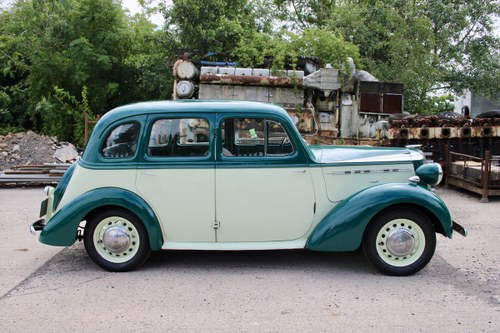
Whichever angle you view it from, ‘Vivien’ is a very pretty car. The two-tone green and cream paintwork is one of the more unusual colour schemes for a 12, but sets off the art-deco lines beautifully.
It’s also a car full of delightful details – the gold medallion ‘Lucas’ imprints in the headlamps, for example, or the aircraft-inspired bonnet scallops, which end in a wonderfully evocative bonnet ornament.
The car isn’t concourse – there are a few scuffs on one of the wings and one headlamp bezel, while the chrome is slightly pitted in places, but these are very minor detractions from what is otherwise a truly lovely car, with a delightful patina.
MECHANICS
The mechanical overhaul in South Africa was carried out by an 84-year old mechanic who is well-known for his work on vintage cars and was carried out to exacting standards, meaning it starts on the button and runs beautifully smoothly, while the recent gearbox repairs will ensure that it should run smoothly for many years to come.
Obviously, a 1937 car won’t fly along at the same speeds as a modern car, but the 12-4 is actually far more competent than you’d expect in modern traffic. The gearbox is simple to operate unlike some vintage cars, the clutch not too snatchy and the performance surprisingly willing – it pulls away in quite a sprightly manner and will happily cruise at 50mph.
The real pleasure, though, is from the whole vintage car experience it delivers, from the soundtrack of the engine and transmission as it picks up speed to the bouncy ride and oversprung seats. It’s impossible to drive a car like this without a smile on your face, while unlike many vehicles of its era, it’s also surprisingly usable. There aren’t many 1930s cars you’d be happy to ‘just pop to the shops’ in – but this is one.
APPEAL
There are essentially three things that give this car such appeal. First, it has immense character and a lovely patina. It has been restored at times in its life, but never over-restored, so is essentially a lovely old car.
The second is its significance – this was one of the most important cars of its era and a genuine influence on the car industry as a greater whole. It brought about advances in manufacturing and safety that give it true historical importance, while this one also has a fascinating history all of its own.
Finally, but perhaps most pertinently, it’s a vintage car that you can use quite happily in most everyday situations – perhaps not as a motorway cruiser, but for general everyday driving, it’s an 83-year old car that you can jump in and drive without too much fuss.