
Description
H&H Classic Auction @ The Imperial War Museum, Duxford/ Cambridgeshire
14th June, 2023 13:00
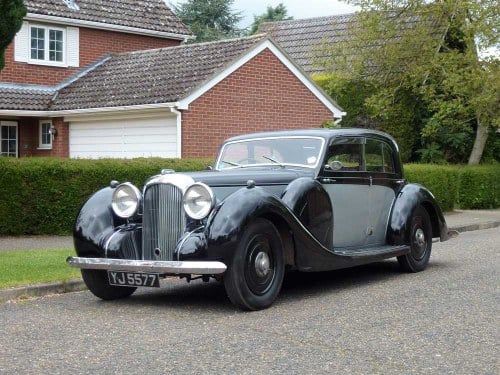
1938 Lagonda V12 Sports Saloon
Estimate
£50, 000 - £70, 000
Registration No: YJ 5577
Chassis No: 14011
MOT: Exempt
Supplied new as a Drophead Coupe and then returned to the factory and rebodied as a Sports Saloon at the request of its first owner Repatriated from Switzerland by the renowned dealer Lukas Huni during 1999 prior to entering the current family custodianship a year later
The subject of a major engine overhaul by marque specialist David Wall and little used since
The most technologically advanced motor car to come out of Britain pre-WW2
Of the half-dozen patrician motor cars still remaining on the world market, none ever inherited such a rich patrimony of design as the 12-cylinder Lagonda . . . It is a new-born car, unrelated to any yet on the road - here or on the Continent . . . Such is the 12-cylinder Lagonda - a car destined to rank from now on, among the greater names in motoring history'. (Lagonda Press Release, August 1937) The most technologically advanced motorcar to come out of Britain pre-WW2, the Lagonda V12 had few international peers. Bugatti's Type 57 may have boasted a similarly exotic overhead camshaft powerplant but its chassis layout was positively archaic by comparison. Mercedes-Benz's 540K could match the British car's power output but only when its refinement-compromising supercharger was engaged, while Hispano-Suiza's J12 needed over twice the cubic capacity to develop an extra forty horsepower! A landmark design, the Lagonda will forever be notable as the world's first production car to feature an overhead camshaft V12 engine. Debuting in prototype guise at the October 1936 Olympia Motor Show (but not officially launched for another year), the Lagonda V12 was engineered by a crack team of ex-Rolls-Royce employees including W. O. Bentley, Stuart Tresillian and Charles Sewell. A 'clean sheet' design that aimed to marry limousine refinement to sportscar performance, it was based around a substantial cruciform-braced box-section chassis. Boasting sophisticated unequal-length wishbone independent front suspension actuated via unusually long torsion bars and special shackle pins that helped obviate side thrust on its semi-elliptic rear leaf-springs, the newcomer also incorporated a Marles steering box, Salisbury hypoid rear axle and Lockheed hydraulic drum brakes. Singularly advanced, the model's aero-engine inspired 60? V12 featured overhead camshafts (one per bank), twin SU carburettors, a combined duplex-chain / gear-driven timing system and Lanchester-type vibration damper. Displacing 4480cc (bore 75mm x stroke 84. 5 mm) the unit was quoted as developing 180hp @ 5, 500rpm. Available in 10'4", 11'0" and 11'6" wheelbase lengths, the Lagonda flagship was among the fastest cars of its generation. Though, the provision of a centre-change four-speed manual gearbox (with synchromesh on the top three ratios) and conventional pedal layout made it surprisingly easy to drive. Beguiled by in-house stylist Frank Feeley's marvellous creations which seemed to capture the very spirit of the age, most customers opted for factory coachwork. Indeed, such was the flamboyance of Feeley's designs - which looked as if they could have sprung from the drawing boards of Jacques Saoutchik or Figoni & Falaschi - that most external coachbuilders produced bodies with altogether more conservative lines. Some eighty years on and the market has shown a marked preference for factory coachwork. Of the 190 Lagonda V12s produced between 1938 and 1940, a mere 100 are thought to have survived to the present day (though, comparatively few of those still retain their original coachwork). More information to follow