
Descripción
This is Lot 314 in the Bonhams Spring Stafford Sale on April 20 & 21, please see the Bonhams website for full details.
Rare four-cylinder model
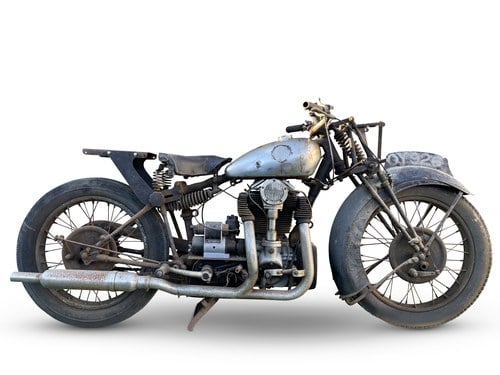
'Barn find' condition
Offered for restoration
Reviewing the v-four Silver Hawk at its launch in the autumn of 1930, Motor Cycling stated that this exciting overhead-camshaft model was "designed primarily to give really high speed, and to give this speed with silence and the added safety of a spring frame".
The early 1930s was a period of severe economic depression, yet the 1931 Motorcycle Show at Olympia in London witnessed the launch of not one but two four-cylinder models aimed at the very top of the market. The ultimate fates of the two newcomers would turn out to be very different however; Ariel's offering - the Square Four - would enjoy a lengthy production life lasting into the 1950s, whereas the rival Matchless Silver Hawk would be gone within four years.
Matchless had introduced another vee-engined model, the twin-cylinder Silver Arrow, the previous year, and the Silver Hawk's design shared many of the 'Arrow's features, most notably the narrow included angle of the cylinders: 26 degrees. Displacing a total of 592cc, the cylinders were contained within one casting and topped by a single 'head, just like the Arrow's, but the Hawk was intended to be a luxury sports-tourer and so enjoyed the advantages conferred by overhead-camshaft valve gear. Drive to the upstairs cam was by shaft and bevel gears, and there was no denying that the v-four Silver Hawk's was one impressive looking motor. The frame and cycle parts followed Silver Arrow lines, incorporating cantilever rear suspension broadly similar to that adopted later by Vincent-HRD. Expensive to make and introduced at the wrong time, the Silver Arrow failed to sell despite its mouth-watering specification and was quietly dropped in 1935.
This incomplete Silver Hawk 'barn find' is offered for restoration and sold strictly as viewed (the engine turns over). The machine comes with a large file containing assorted correspondence; two copies of The Classic Motorcycle; an old-style V5 registration document; various photographs; an HPI check sheet; a substantial quantity of technical drawings and other useful information; and an old-style continuation logbook (1945) showing that the machine had at times been attached to a sidecar.