Descrição
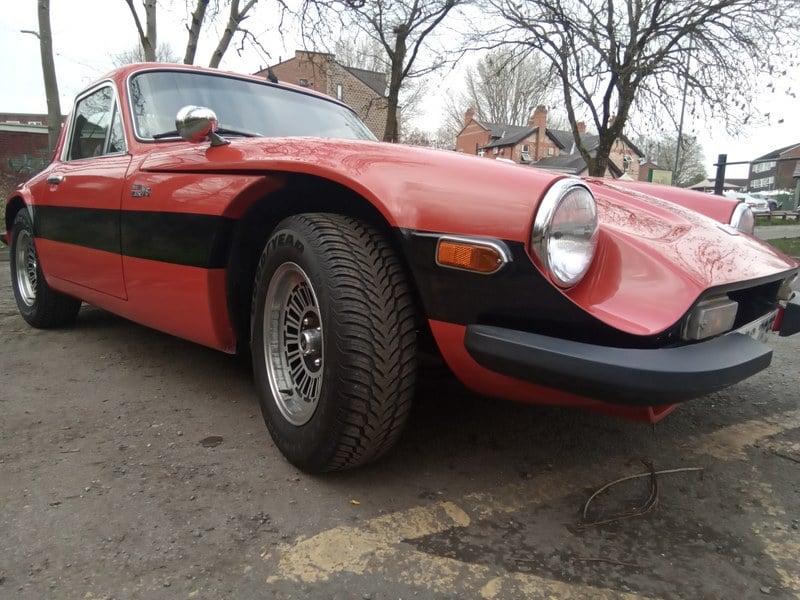
TVR's first significant model, the TVR Grantura, had a particular genesis. Its origins lie in an order placed with TVR by an American from New Hampshire named Ray Saidel. In 1955, Wilkinson designed a tubular chassis with four-wheel independent suspension. He actually borrowed from the Volkswagen Beetle, using the torsion bar front suspension and installing it at the front and rear of the car. The brakes and wheels are also borrowed from this German model. Preceding the TVR Grantura, this coupé, named Jomar after the first names of Saidel's children (JOhn and MARgaret), received its bodywork in the U. S. In 1957, the first TVR 'Coupés' (pre-Grantura) were derived from this chassis, six of which were built as roadsters. Unlike the Jomars, these cars were fitted with Girling brakes and Dunlop wheels. The TVR Grantura as we know it was introduced in 1958. It was built on the tubular chassis of the Jomar, with a particularly stiff suspension that was ill-suited to road use. The car offered a choice of engines: 1. 2-litre Coventry Climax FWE with MGA gearbox (modifiable with Level 2 or 3 kits), 1. 2-litre Ford 100 E side-valve with or without Shorrock compressor, and 1. 5-litre MGA. Many elements were borrowed from production models: BMC B-Series differential, Ford steering box, Ford Consul windscreen, etc. The Grantura's polyester bodywork design was quite original. Although it evolved over time, this curious shape remained the basis of TVR models until the 1970s. The car's very short wheelbase and minimal overhangs (the car does not exceed 3. 50 metres) limit the styling exercise, resulting in a streamlined profile and a surprising rear end. The Grantura also stands out for its panoramic rear window in Perspex (transparent plastic) and its closed fastback stern, with the spare wheel accessible only from the inside. However, the TVR Grantura's handling is excellent, thanks to its dry suspension, light weight of 660 kilos and low ground clearance. It is fitted with large Girling drum brakes (similar to those fitted to the Austin Healey 100-Six) and Dunlop spoked wheels identical to those on the Healey. Hand-built, it can be virtually customised. However, production could not keep up with demand, causing financial problems for TVR, and only one hundred examples of the Mk I were made. The Grantura evolved somewhat in 1960, becoming the Mk II. The changes mainly concerned the mechanical aspects, with most cars receiving the MGA's 1, 588cc, 80bhp engine. At the beginning of 1961, the Mk II A saw further improvements, the main one being the fitting of Girling disc brakes as standard. The engines on offer were the 1. 3-litre Ford Classic, the 83bhp 1. 2-litre Coventry Climax FWE, or the 1622cc engine from the MGA Mk II, the latter of which could be fitted with the HRG-Derrington aluminium cross-flow cylinder head. The car reached speeds of up to 160 km/ h. The Mk II and Mk IIA were the great commercial successes of the Grantura generation, with 400 examples sold. After a prolonged period of inactivity, the vehicle was restored by its previous German owner between 2012 and 2013. The bodywork was repainted in its original Racing Green colour, and the interior was completely redone. The seats, rear window, sunroof, tyres and many small parts have all been replaced, as has the electrical system. On the technical side, everything is fully functional and original. The Ford Pre-Crossflow 1, 500 cm³ engine develops 64 bhp, works perfectly and emits a superb, throaty sound.