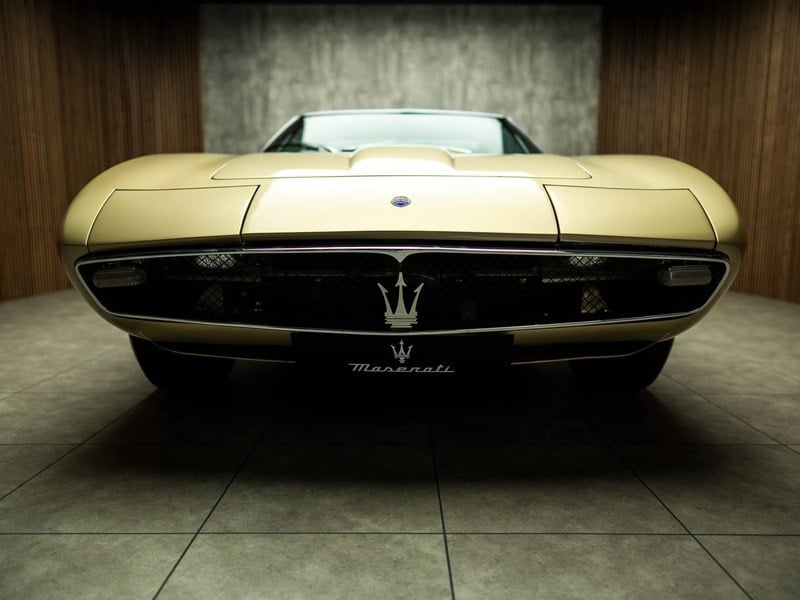

Description
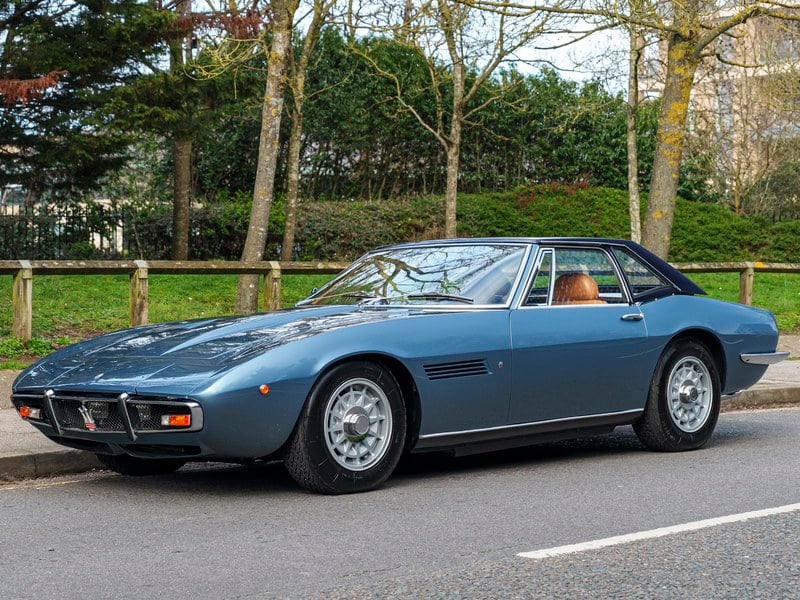
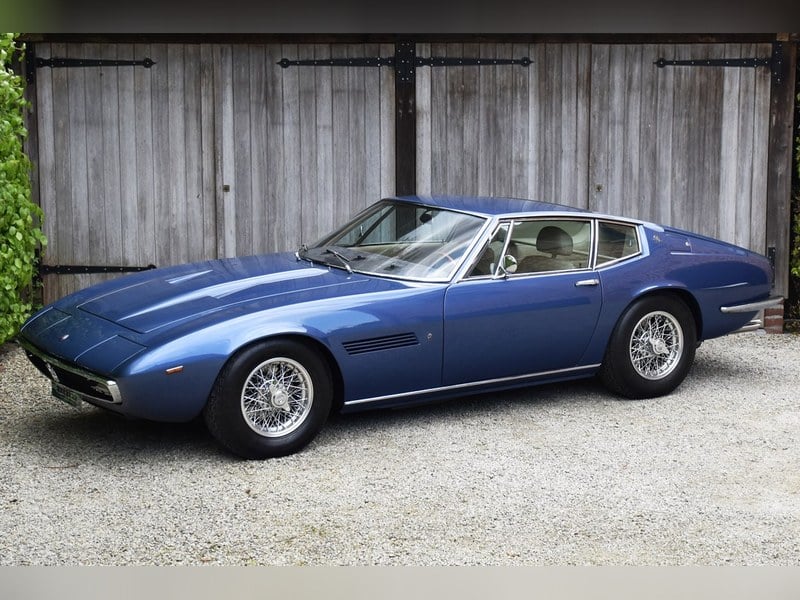
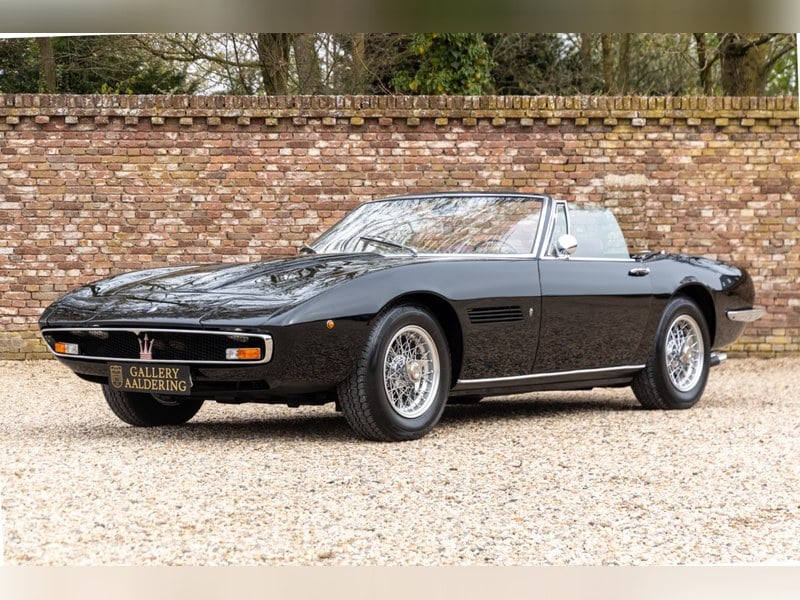
** Maserati Ghibli – the most beautiful and expensive Gran Turismo of the late 1960s** When the talk turns to Maserati styling, the Maserati Ghibli, the masterpiece of Giorgietto Giugiaro, is usually the car that comes to mind. A long bonnet, flowing lines, large windows, a short rear end – this design, with its maximized elegance, became immortal. Even today, the Ghibli impresses with its captivating beauty, but not only that. The Ghibli has classic sports car proportions: a long bonnet, a short passenger compartment, a sleek rear end, pop-up headlights, and bumpers used as styling elements. Yes, today it may even look more timeless than all its competitors – or not? This wonderful shape, a tubular frame chassis – and a V8 engine that was among the finest of its time. It initially came with a 4. 7-liter displacement and was a direct descendant of the racing engine that had powered the legendary 450S from 1956 and later the magnificent 5000 GT. An aluminum cylinder block and heads, four overhead camshafts, and four Weber downdraft twin-barrel carburetors (40 DCNL 5). A similar engine was also used in the Quattroporte, but the Italians dispensed with dry sump lubrication there; however, it was necessary in the Ghibli because otherwise, the low-slung front end would not have been possible. The first version produced 330 hp, and from 1970 onwards there was the SS 5000, with a 4. 9-liter displacement and a guaranteed 335 hp, both at 5500 rpm. Good torque, 440 Nm at 4000 rpm in the 4700 version, and 480 Nm in the SS 5000, ensured effortless driving. Even today, the sound of a Ghibli engine is considered some of the finest music in the automotive world, somewhere between the throaty rumble of an American V8 and the characteristic Italian scream. And: the Ghibli's engine proved to be significantly more durable than the V12 engines of its competitors; it also allowed for longer journeys on highways at high speeds. The transmission was a 5-speed ZF unit. Only the design of the rear axle suspension was perhaps a little too conservative. The Maserati designers were criticized for using a Salisbury solid axle with leaf springs. However, in actual driving, the relatively simple design offered hardly any disadvantages; it was comfortable, very quiet, and it didn't deter customers from buying the sports car. While the Ghibli was often available in red and yellow, many customers preferred their coupe in metallic paint colors, which emphasized the car's lines even more. Our coupe was built on [date] and painted red at the factory. During the restoration, the current owner repainted the completely stripped body in a beautiful metallic shade. Matching Connolly leather was used for the interior. Together with Wilton wool carpeting in a matching color, this creates a harmonious, tone-on-tone combination. This color combination suits the Ghibli perfectly and fully showcases its stunning design. Its competitors were the Ferrari 330 GTC, the 275 GTB (and later the 365 GTB Daytona) and the Lamborghini 350 GT/ 400 GT. The Lamborghini Miura belonged to a different category; its mid-engine layout was too close to a racing car. The Ghibli never aspired to be a racing car; it adheres to the classic Grand Touring concept. Accordingly, its engine is located at the front, it has ample storage space for longer journeys, and even non-acrobats can easily get in and out. Tall drivers can sit comfortably in the car; the seats and seating position are very comfortable, and the cockpit is flooded with light thanks to the large windows. Giugiaro, the head designer at Ghia in the mid-1960s, designed the Maserati Ghibli in about three months. He created a timeless beauty that would influence other vehicles for decades to come. He had ample space to work with. A width of 1. 8 meters, a height of 1. 16 meters, and a length of 4. 59 meters provided an excellent foundation for an elegant and dynamic design, especially when practicality wasn't a major consideration. But few designers exploited these possibilities as well as Giugiaro. The Ghibli was first shown in November 1966 at the Turin Motor Show. The magazine "Automobil Revue" wrote at the time: _“This newcomer from the house of the trident (Neptune’s symbol) is a prestigious two-seater, clothed by Ghia in a truly sensational way. It is based on the shortened chassis of the Maserati Mexico, with a wheelbase of 255 cm. The 4. 7-liter V8 engine, with its four camshafts and 330 DIN hp, was carried over. To reduce the height of the front end, a dry sump lubrication system was used. The smooth surfaces of the harmonious body give the model, named “Ghibli” (desert wind), the necessary visual elegance. The Maserati Ghibli is one of the most beautiful models shown in Turin.”_ ** ** ** At the forefront of the sports car class** As Paul Frère (1968 in Motor Revue) and Reinhard Seiffert (1969 in Auto Motor und Sport magazine) confirmed, the Ghibli was a true sports car. It needed only 7 seconds to accelerate from 0...