Beschreibung
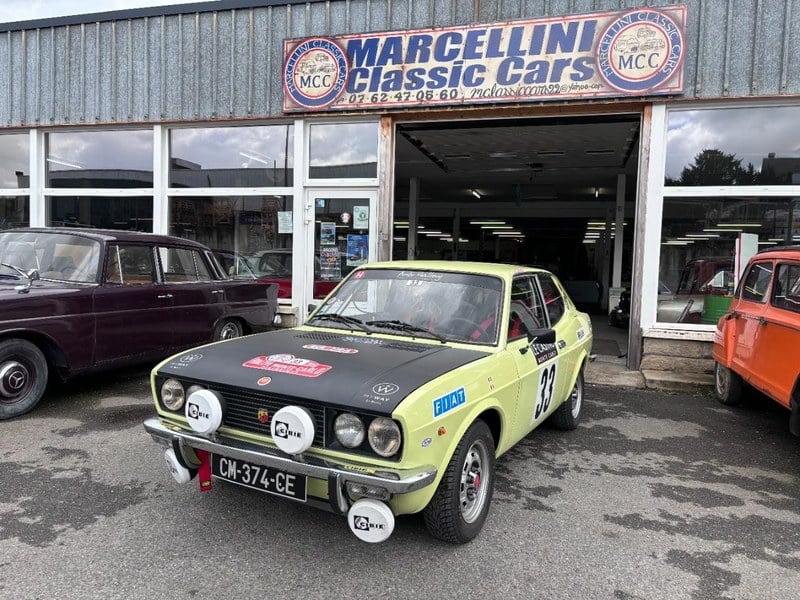
Wundervolle und hervorragend restaurierte Fiat 128 Rally von 1972. Fahrzeug mit schwarzen Nummernschildern und einem Fahrzeugschein mit Seiten aus der ersten Zulassung, Provinz Varese. ASI-Goldplakette homologiert. Monta sportliche Leichtmetallräder aus der entsprechenden Periode. Der Rally zeichnet sich durch die vordere Stange und die Nebelscheinwerfer aus.
Geschichte des Modells und Kuriositäten
Die Fiat 128 Rally wurde auf dem Genfer Salon im März 1971 vorgestellt und trotz der Rolle als Ersatz- und Provisoriumsprodukt erhielt er einen lobenswerten Verkaufserfolg, auch dank des erschwinglichen Preises und der guten Leistungen.
Die wesentlichen Unterschiede des Rally im Vergleich zur davon abgeleiteten 128 Limousine sind wirklich gering. Ausgenommen dem Motor und der Einführung des Servobremsystems, betreffen die augenfälligsten Verbesserungen die Scheinwerfergruppen, die äußeren Zierleisten und die umfangreiche Überarbeitung des Innenraums, ausgestattet mit umschlungenen, neigbaren Sitzen mit verstellbaren Kopfstützen, hinten klappbar öffnende Scheiben, neue Bezüge, zentrales Ablagefach auf dem Boden. Das Armaturenbrett, identisch mit dem der Limousine, war verziert durch eine Instrumentierung, die durch Hinzufügung von Drehzahlmesser, Öldruckmesser und Wassertemperaturanzeige ergänzt wurde. Es befindet sich ein zweispeichen, gelochtes Lenkrad mit kleinem Durchmesser und Lederkrone. Auch die Pedale wurden neu gestaltet, wobei das Gaspedal so geändert wurde, dass Heel-and-Toe leichter gelingt.
Außen wirkt es aggressiver durch seitliche Klebefolien, vorderen Stoßfänger, der als Träger der zusätzlichen Rally-Scheinwerfer dient, vier runde Scheinwerfer im Heck (tatsächlich von der 850 Coupé geerbt) und die Möglichkeit, Leichtmetallräder zu bekommen.
Ende 1972 wurde ein leichter Restyling vorgestellt, das einige Innen- und Außendetails betraf: Innen wurden neue optionale Sitze angeboten, deren Mittelteile rot- oder ockerfarbigem Stoff vorgesehen waren (je nach Außenfarbe) mit schwarzen Seitenflächen aus Kunstleder; außerdem verschwanden die verchromten Ringe um das Zusatzinstrument; Außen wurde am vorderen Stoßstangentubus eine schwarze Dichtung installiert sowie um den Umriss der Rally-Schilder auf der Motorhaube und dem Kofferraumdeckel; auch die äußeren Griffe erhielten eine leichte Überarbeitung mit dem beweglichen Teil in Schwarz; schließlich verschwanden am hinteren Stoßfänger die Zacken zugunsten einer schwarzen Gummidichtung, die sich entlang der gesamten äußeren Kante zieht.
Die Leistung, obwohl sie sich nicht allzu stark vom Ursprung abhebt, stieg moderat an, bei gleichzeitig leicht gestiegenem Kraftstoffverbrauch. Die Mechanik der "128", gerade als Auto des Jahres benannt, repräsentierte zu jener Zeit die technologische und leistungsbezogene Spitzenklasse ihrer Kategorie und zeigte ihr Entwicklungspotenzial.
Der Fiat 128 Rally wurde zum Preis von 1. 220. 000 Lire franco filiale verkauft (14% mehr als das Basismodell), mit einer begrenzten Auswahl an Optionalzubehör, darunter Anti-Diebstahl (7. 000 Lire), wärmeschutzverglasung mit beheizter Heckscheibe (21. 000 Lire), vordere Sicherheitsgurte (10. 000 Lire), Windscheibe mit eingebauter Radioantenne (15. 000 Lire) und Magnesiumlegierungsräder (50. 000 Lire).
Die Farbauswahl umfasst Weiß, Rot-Orange, Arktikgrau und Gelb, keines davon metallisch, mit Innenausstattung aus schwarzer Kunstlederoptik, alternativ Kunstleder und Stoff rot oder ocker in der mittleren Sitzzone.