Description
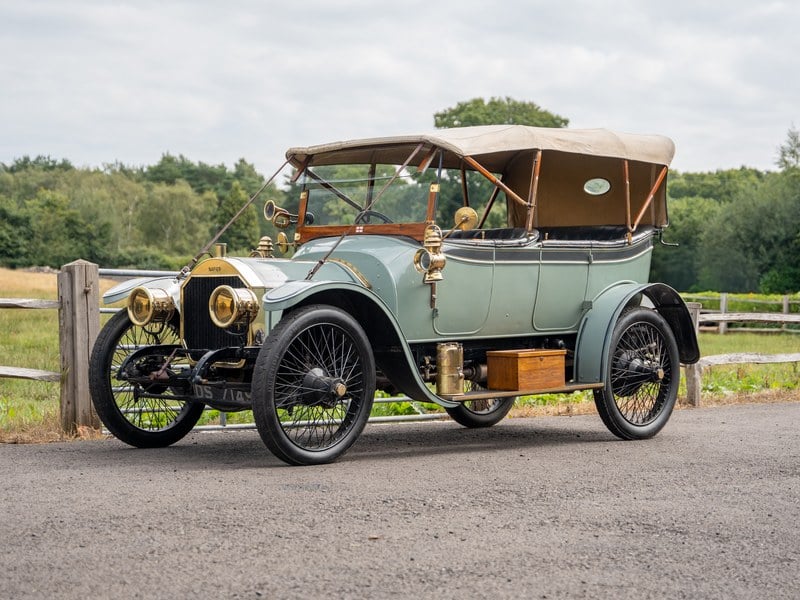
1912 Napier 15HP T46 Gentlemen’s Coupe
Registration No. LD3440
Chassis No. 9411
Engine No. 18385
VCC Dating Certificate No. 1246
‘Ex Boland Collection, Ex Sykes Collection’
‘Displayed at Brooklands Motor Museum’
Founded In 1808 by Scottish engineer David Napier, Napier & Sons of Soho, London were engineers of precision machinery for printing bank notes and making coins. David Napiers son, James joined the family business in 1837 and became a partner 10 years later. James succeeded his father as head of the business in 1867 and specialised in coin making machinery and presses for printing notes and stamps. James proved to be an exceptional engineer but very poor business man, with the firm going from 300 employees in the early 1800s to just by 1895. He made many attempts to sell the business but couldn’t. In 1870, James’s son Montague Napier was born, he inherited the faltering company in 1895 along with his father’s engineering talents.
Montague was a cycle racing fanatic and at the Bath Road club, he met an Australian named S. F. Edge, who at the time was a manager for Dunlop Rubber Company and colleague of the notorious H. J. Lawson. Edge was one of the early pioneers of motor racing, beginning with Tricycles and moving onto to cars. Edge managed to purchase from Lawson, the 6HP Panhard et Levassor (No. 8) that had finished second in the 1896 Paris - Marseille - Paris road race but was dissatisfied with the cars performance and thought that there had to be a British engineer that could make a car at least as good as the Panhard. It was this car that was commissioned by Edge to be reworked by Montague Napier. Napier had by this point experimented with the combustion engine, making a Twin Cylinder, water cooled unit to which Edge was very unimpressed with. He did however note Montagues ‘uncommon engineering ability’ and thought it was best to start by improving cars that were already successful. Montague was tasked with improving the steering of ‘No. 8’ and with the fitment of a steering wheel (tiller originally) the car was transformed. Edge began to give Montague more and more tasks, and eventually commissioned the manufacture of a complete 2 cylinder engine, which featured electric spark ignition, it was a massive success.
As time went on, Edge persuaded Napier to go into production of motorcars on the premise that he would purchase all of them, therefore effectively becoming Napiers salesman, in a similar fashion to that of Rolls and Royce.
Fast forward to 1912 and Napier had become a superpower in the automotive industry, in Britain, producing the highest quality cars that could only be matched by the likes of Rolls Royce. Cars were sent to all parts of the world and models varied for their targeted audiences. The example shown here is that of the 15HP ‘Noiseless Napier Doctors Coupe’. The car was marketed to meet the requirements of Doctors and other professional gentlemen having use for a small 4 cylinder car ‘which will climb anything in the way of a hill, with a good turn of speed’.
The example shown here today, has been extensively campaigned throughout its lifetime and has been in several notable collections over the years (Boland, Sykes). Little is known of the car’s early history, however it surfaced in 1968, when R. J Evans, curator of the Manx Motor Museum, met noted Veteran car collector James Boland who revealed he had a 1912 Napier 15HP in a dismanted state. Evans was looking for an early car and a deal was agreed upon the swap of the Napier for a 3 Litre Lagonda.
The dismantled Napier was then amazingly transported to The Isle of Man, in the back of a 1924 Rolls Royce hearse. A meticulous restoration then began, which spanned some 4 years, being featured in the VCC Gazette winter 1971 - 1973 (in file). All mechanical items were rebuilt at this time as required, including the axles, brakes, steering and suspension. The 2. 8 Litre four cylinder engine and 3 speed gearbox were also rebuild at this time. Evans wanted a Coupe body so he carefully measured the coachwork on a DH Coupe owned by John Campbell-Lambert and made a replica in 20-gauge steel, incorporating a few subtle upgrades in the interests of durability and taking great car to eliminate any squeaks or rattles on rough road surfaces. The floorboards are solid oak and the roof is three-ply covered in black leathercloth with a small central skylight framed in brass. Much effort also went into ensuring that the rear-hinged doors fitted perfectly, with elegant brass surrounds for the door windows and for the windscreen with its distinctive curved corner sections, the glass being specially made by Triplex. The upholstery was trimmed in Bridge of Weir leather with horsehair stuffing, great care being taken to get the diamond-pattern buttoning right.
The electrics were all renewed and a more modern Dynostart was fitted to save the effort of cranking over by hand, along with a more effective charging system and an electric fuel pump. Evans eventually sold the car to Veteran car collector Bill Sykes of St Neots in 2008, who commissioned Nigel Parrott of NP Veteran Engineering to recommission of the car and improve its running. It was then used extensively on VCC events, including a tour of Ireland and a return visit to the Boland Collection from where it had originated 50 years before.
Old MOTs imply that it has covered some 4, 600 miles since 2008. It is also shown in the file that the car was displayed in Brooklands Motor Museum alongside the Napier Railton.
In 2022, the car was in need of some mechanical work which was a complete strip down and rebuild of the engine, of which all work is accurately detailed within the file. The car today is starting, running and stopping extremely well with a trip of 120 miles travelled in very recent times. As you can see in the photos, this impressive Edwardian machine looks most imposing with a full set of brass electric lamps (working)and a comprehensive array of dash instruments including a Stewart speedo, oil pressure gauge, water temperature gauge, fuel gauge, 8-day clock and CAV lighting system.
Documentation includes a V5C, an older V5C and V5; four old MOTs; VCC Dating Certificate; magazine features; notes on starting and driving and some useful technical literature including a copy of a 52-page Napier maintenance manual.
It is also important to note that since 2023 the car has been subject to a large amount of expense, with work to the electrics, engine, steering, wheels, brakes, clutch and bearings. Upon receipt of the car, Tom Parrott has covered around 70 trouble free miles, with the car ambling along at 40mph.