
Beskrivning
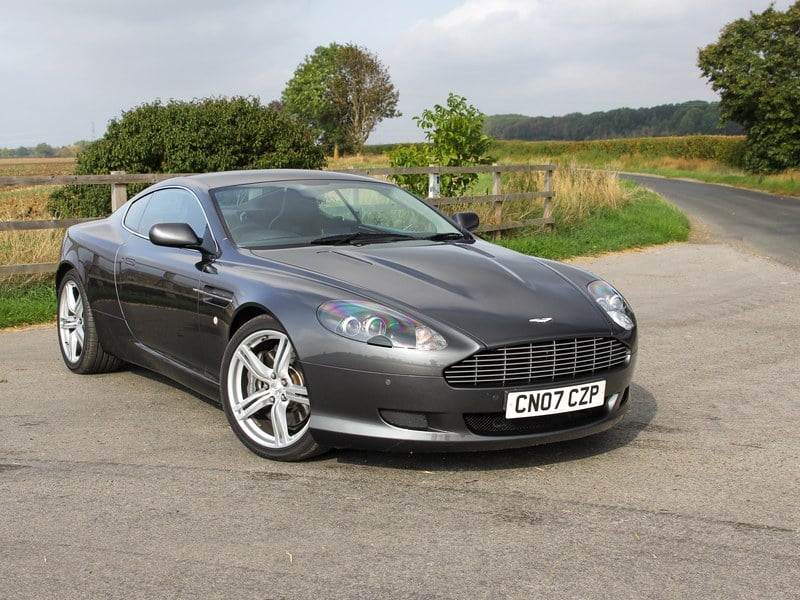
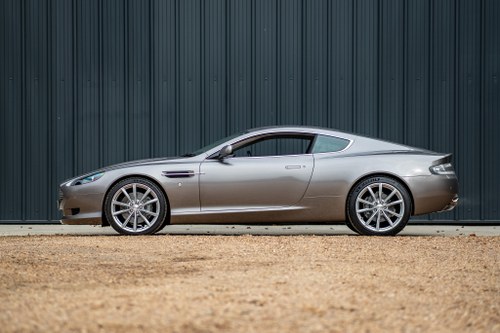
** DEPOSIT NOW TAKEN** With only 10, 145 miles recorded at its January 2026 MOT, this early Aston Martin DB9 immediately stands apart from the vast majority on the market. Finished in Tungsten Silver over Falcon Grey leather, it was ordered in August 2006, supplied new by Harwoods of Sussex in March 2007, first delivered to Mr T Gill and has had just one previous keeper.
It comes with a wonderfully reassuring paper trail, including its original owner’s book pack, the original bill of sale showing a remarkable new price of £117, 395. 12, and a comprehensive service record supported by original invoices. Servicing is recorded with Harwoods in 2008, 2009, 2010, 2013 and 2016, followed by Aston Martin main dealer attention at Walton on Thames in 2019 and again in 2020, the latter at a cost of £7, 761. 21, then Aston Martin Nottingham in 2021 and AM Works Service, Newport Pagnell in 2023. Since then the car has been kept in private or professional storage, exactly the sort of life you would hope for from a low-mileage V12 grand tourer of this calibre.
The more recent history is especially appealing. In 2020 the car received new tyres and rims via HWM, while in 2023 AM Works Service at Newport Pagnell treated the underside with Lanoguard. It is clear that this has not been a car allowed to drift into casual ownership or indifferent maintenance. Instead, it has been preserved properly, used sparingly and supported by the right names.
The mileage story is also easy to understand. The vehicle history report flags a discrepancy where the odometer appears to reduce by 199 miles between June 2018 and February 2019, but the report itself notes that this appears to be the result of a DVLA mileage entry being rounded to the nearest thousand rather than any genuine concern about use or tampering. The broader mileage record supports that conclusion, showing a consistent, low-use pattern from year to year and culminating in the current 10, 145 miles.
And that, really, is what makes this DB9 so compelling.
Early DB9s represent one of the great modern Aston Martin bargains. Here is a genuinely beautiful Ian Callum-designed V12 grand tourer from the period when Aston Martin still seemed to build cars with one eye on old-world craftsmanship and the other on effortless pace. For the money, very few cars offer the same sense of occasion: the long bonnet, the compact cabin, the soft leather, the central push-button start, and of course that magnificent naturally aspirated 5. 9-litre V12. Yet values for ordinary examples have remained remarkably accessible.
The reason, as ever, is that the market has become more selective. Buyers know that cheap DB9s can quickly become expensive ones, so the best cars increasingly stand apart. Correct colours matter. Ownership matters. Provenance matters. Evidence of proper upkeep matters. Low mileage certainly matters. When all of those things come together in one car, the value conversation changes completely.
Tungsten Silver over Falcon Grey is timeless. The ownership story is pleasingly restrained. The history file is substantial. The mileage is extraordinary. And the way it has been stored and maintained suggests a car that has been appreciated as an Aston Martin should be, not merely used up.
In a market full of tempting DB9s, this one feels rather more special than that. It is not simply an early DB9 at an attractive price point. It is an unusually well-preserved, low-owner, low-mileage, properly documented car that now occupies a league of its own.
For the buyer who understands the difference between a merely available DB9 and a truly collectible one, this looks a very smart place to put one’s money.
Model History
Launched at the 2003 Frankfurt Motor Show, the DB9 was the car that properly reintroduced Aston Martin to the modern grand touring world. It replaced the DB7 and was the first model built at Aston Martin’s then-new Gaydon facility, sitting on the marque’s VH architecture and powered by the now-famous 5. 9-litre naturally aspirated V12.
Where the DB7 had charm and elegance, the DB9 added real modernity. It was lighter, stiffer, more spacious and far more resolved as a driver’s car, while still delivering the sense of occasion Aston Martin owners expected. Ian Callum’s design remains one of the most successful shapes of the era: muscular but restrained, unmistakably British and beautifully proportioned.
In period, the DB9 appealed because it could do many things at once. It was fast enough to feel genuinely special, comfortable enough to cross continents, and beautiful enough to make almost everything else look needlessly fussy. Available as both coupé and Volante, and with manual or Touchtronic transmission, it quickly became one of Aston Martin’s defining modern models.
Today, the DB9 occupies a particularly interesting place in the market. It is still undervalued relative to its looks, badge and engine, especially when compared with many lesser cars now commanding surprisingly ambitious money. But the days of indiscriminate bargain hunting are fading. Buyers increasingly recognise that the right DB9; well maintained, well specified, properly stored and supported by strong provenance, is a very different proposition from a tired or compromised example.
That is why the very best early cars are becoming harder to buy. They offer the purity of the original design, the charisma of the naturally aspirated V12 and, in special cases such as this, a level of ownership and preservation that is simply not easy to replicate.
** Marketed for sale by Auto Classica Storage on behalf of our client. Viewings by Appointment Only**
Private Plate not included in the sale and no longer assigned to the is vehicle.