
Beschrijving
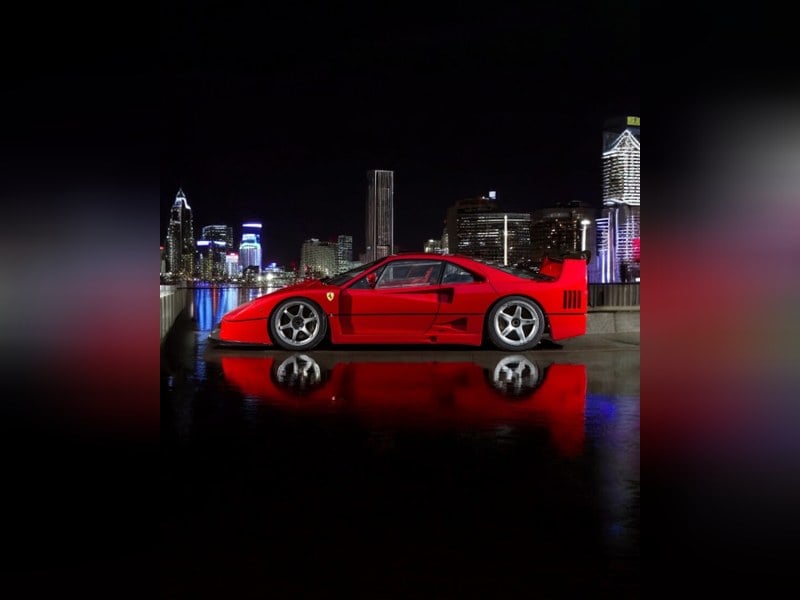
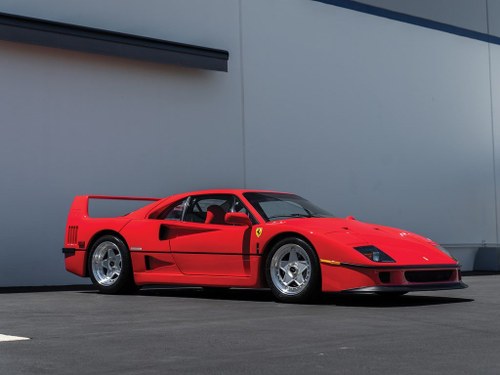
To Be OFFERED AT AUCTION at RM Sothebys' Monterey event, 15 - 17 August 2019. Offered from the Ming CollectionOne of just 213 built for the U. S. marketOnly 1, 705 miles from new; highly original exampleIncludes owner’s manuals, tool set, and compressed air bottleMaintained in climate-controlled facility; serviced in March 2019Ferrari Classiche–certified; original engine and gearbox Only one event happened slowly in Enzo Ferrari’s life, and he got it out of the way quickly. His birth certificate is said to have been issued a few days late in February 1898 due to a debilitating snowstorm in his native Modena, Italy. Everything else in il Commendatore’s life came at a rapid pace. Ferrari was just 10 years old when he watched the Circuito di Bologna car race, one of the first organized road races in what would become the seat of supercars. To say that the experience whet the young Ferrari’s appetite is an understatement. Ferrari completed his military service during World War I and moved to Turin, where he begged Fiat to bring him on to do just about any task. Fiat turned him down, perhaps the greatest hiring mistake the company would ever make. Ferrari instead took a job at fledgling car builder C. M. N. in Milan and by 1919 found himself at the starting line of the Parma-Poggio di Berceto hill climb. Ferrari attracted the attention of Alfa Romeo, and the two would enjoy a complex relationship over the course of the 1920s and 1930s. Ferrari proposed his own race team over dinner one night in Bologna, and by 1932 Alfa Romeo 8C racing cars were emblazoned with the prancing horse of Scuderia Ferrari. The team would function as a quasi-arm of Alfa Romeo until 1939, when Ferrari left the company to build his own race car. Ferrari agreed not to brand the car under his own name for four years, something that seemed like an unfortunate consolation at the time but would prove irrelevant during the ensuing war. By 1947 Ferrari rebuilt its Maranello factory near Modena to build road and race cars. Its first engine was a V-12 penned by Gioachino Colombo, an engineer who had apprenticed under Vittorio Jano at Alfa Romeo. Post-war Alfa Romeo was focused on four-cylinder cars rather than high-end sports cars, so Ferrari was largely alone for more than a decade in producing high-performance sports cars in Italy. Enzo remained at the helm of the automaker that bore his name for the next forty years, and he ensured that Scuderia Ferrari would always drive development of road-going Ferraris. The company’s sports cars eventually became supercars, spurred by competition from Lamborghini in Bologna and Porsche in Stuttgart as well as by rapidly evolving racing rules. By the mid-1980s, Enzo himself knew that his days at the helm would eventually come to an end, and he wanted that end to come on a high note. Enzo Ferrari’s pursuit of perfection resulted in the F40, and yet its execution was not simply an exercise in what could be done in Maranello. The F40 traced its roots to the 288 GTO, a homologation special designed for Group B racing that never materialized. Spurred by the commercial success of the 288 GTO, Ferrari had a ferocious twin-turbocharged V-8 engine ready for an outlandish body and a fine-tuned chassis. The car that debuted in 1987 looked like nothing Ferrari had done before. Pininfarina was commissioned to draw its angular lines, including the massive table-top rear spoiler. Certain cues, such as its wedgy shape, quartet of round taillights, and numerous air intakes, recalled the 288 GTO. And yet the F40 was clearly its own, a dramatic and controversial model that drew reactions like no Ferrari before. It was just what Enzo had in mind. Its carbon fiber, Kevlar, and aluminum construction ensured that it was obsessively light—as little as 2, 400 pounds dry—a remarkable feat for a relatively large sports car with a monster of an engine. Of course, the F40 was not a styling exercise. Plainly visible beneath the clear, louvered engine cover behind the passenger compartment was an enlarged version of the twin-turbo V-8 that powered the 288 GTO. A pair of IHI turbochargers teamed with Weber-Marelli electronic fuel injection delivered power in excess of 470 horsepower and a torque rating higher than 425 foot-pounds, though each car built was relatively bespoke. A five-speed manual transmission shuttled power to the rear wheels. Big Brembo brakes were behind 17-inch wheels held in place by special octagonal center locks. Underneath, the suspension was again based on the 288 GTO with a double-wishbone design. Later European-market models were built with a height-adjustable suspension. Inside, the F40 was intentionally spartan, especially in contrast to the technology-laden Porsche 959 with which it was inevitably compared. Porsche intended for the 959 to be a flagship, combining luxury with performance and grip, while the F40 was narrowly focused on sheer driving performance. Its plain dashboard featured a rudimentary air-conditioning system largely intended to be used between track stints, but no audio system, carpeting, or power features were otherwise available. Period automotive publications measured a 0–60 mph sprint in the 4. 2-second neighborhood and a top speed that tickled 200 mph. Britain’s Autocar called it “scintillatingly fast.” Car and Driver, after borrowing a privately owned example in 1991, reported, “Nothing we’ve ever driven can match the mix of sheer terror and raw excitement of earth-scorching around in someone else’s three-quarter-million-dollar toy.”On paper, the F40 was priced at about $400, 000 when the first of 213 bound for American shores began to arrive. None likely sold for that price, of course, as the car arrived during the Ferrari market’s late-1980s skyrocketing. This example, finished in the traditional Rosso Corsa over red cloth seats, was delivered on 25 February 1991 to Classic Ferrari, Inc., in Richardson, Texas, and sold to the original owner, James M. Brown of Dallas, on 4 March. Shortly thereafter, the F40 was displayed at the 1991 Hillsborough Concours alongside a 959 in a celebration of modern supercars. In January 2000 the car was awarded a Platinum Award at the Cavallino Classic and not long thereafter arrived in the Ming Collection. In 2004 the car was fitted with the useful European-market variable-height suspension system. Since then, the vehicle has been obsessively maintained in a private, climate-controlled facility and has only accumulated a handful of sparingly driven miles since. Age-related maintenance was performed regardless of when the car was driven, and it was most recently serviced in March 2019. With only 1, 705 miles showing at the time of cataloguing, and fully serviced, this example is among the top tier of all U. S.-specification F40s extant. Offered with its original manuals housed in a leather folio, parts and workshop manuals, factory tool kit, compressed air bottle, and Ferrari Classiche certification, this F40 represents the pinnacle of the world’s foremost fast-moving automaker. To view this car and others currently consigned to this auction, please visit the RM website at rmsothebys. com/ en/ auctions/ mo19.