
Beschreibung
Chassis number: 35794
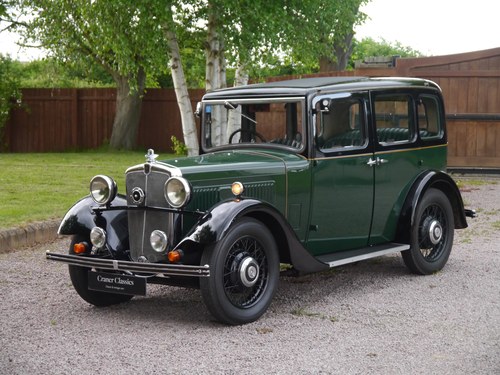
Morris 10 sliding head extensively restored to this very high standard in black and green paintwork. Beautifully restored including interior and headlining, This really is one of the top better ones you’ll probably find it really is striking the Car really does need to be seen to be appreciated and will surely not disappoint, it comes with a lovely little history file and lots photographs, The Morris Still contains its original pytchley emblem plaque from the company who made the sliding head roof, It also contains its original emblem from the dealer. The Chrome work is in very fine order.
Morris built several models using Pytchley’s technology from 1932, including the Morris Minor, Morris Major and Morris Ten adding what became known as a Sliding Head (using the term head in the same way as Folding Head or Drop Head). This comprised a panel which could be slid back over the roof behind to create an opening above the driver and passenger. The sliding panel also incorporated locks which allowed the panel to be fixed at any position from fully closed to fully open. By 1935 Wolseley were using the Pytchley roof and by 1936 Austin too were also selling models with the sliding head. The Hillman Minx was another low-cost small car which was clearly not designed to be chauffeured, and in 1931 it was offered in a variety of body styles as was usual at that time, among the options was a sliding roof section including, on the 1933 Aero model with glass panels, as photographed on the 1932 show car, making this the first moonroof. In 1941 Pytchley took on the manufacturer Vauxhall for failure to pay royalties. Vauxhall claimed that their variation of the sliding roof, which slid the panel under the rear section rather than over, was sufficiently different to mean that a license need not be paid. Pytchley won the case.
The Morris Ten announced 1 September 1932 is a medium-sized car introduced for 1933 as the company’s offering in the important 10 hp sector of the British market. It continued through a series of variants until October 1948 when along with Morris’s Twelve and Fourteen it was replaced by the 13. 5 hp Morris Oxford MO.
Morris Ten was a new class of car for Morris now equipped with wire wheels and a new type of mud guarding—domed wings with wing side shields—it was powered by a Morris 1292 cc four-cylinder side-valve engine employing a single SU carburettor which produced 24 bhp at 3, 200 rpm. The gearbox was a four-speed manual transmission unit, behind a wet cork clutch and Lockheed hydraulic brakes were fitted to 19 inch wheels. Early models had a centre accelerator pedal and large sidelamps on the wings, the propeller shaft had Cardan (Rag joint) disc couplings made from leather. After 1933 wheels became 18 inch and the accelerator pedal was moved to the right of the cluster to become the modern convention.
The October 1932 Olympia Motor Show introductory prices:
chassis £127. 10. 0
coach-built saloon with sliding head £169. 10. 0
special coupé with sliding head £195. 0. 0
Body styles at launch in August 1932 were restricted to a saloon and two-door coupé, but a four-door tourer joined the range in December, followed in 1934 by a two-seater with dickey seat and a Traveller’s Saloon.