
Description
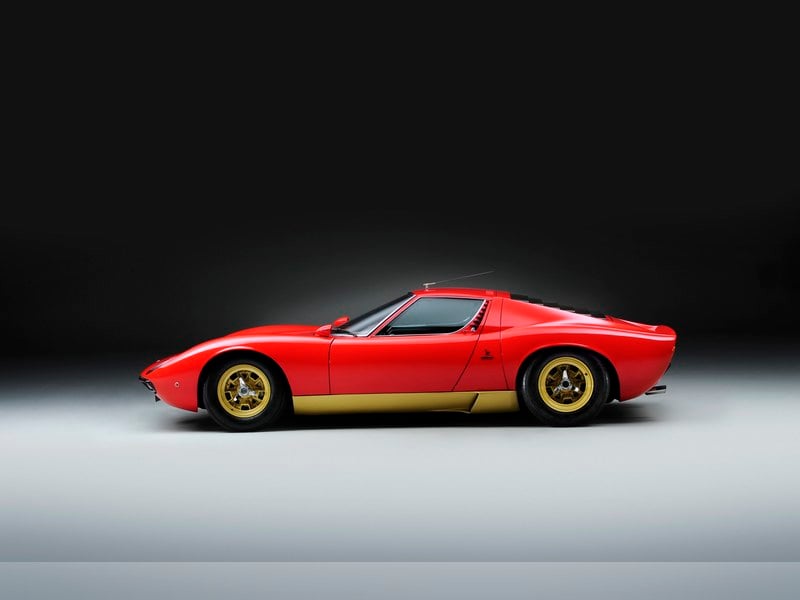
Lamborghini’s Miura is considered as one of the most iconic cars in automotive history for its sleekly curvaceous shape, mid-transverse V12 engineering and supercar genesis. It was created in1965 under the constellation of talents of the following 5 men:
- Giampaolo Dallara, an aeronautical engineer from Polytecnico di Milan who brought his extensive experience on developing mid-longitudinally mounted V6 and V12 units in Ferrari SP/ 156 F1 and Maserati Tipo 63 respectively,
- Giotto Bizzarrini, an automobile engineer from Universita di Pisa who was extensively involved in the development of the Colombo V12-equipped Ferrari 250 GTO and later on the mid-longitudinal V8 engined ATS 2500 GT road car,
- Paolo Stanzani, a mechanical engineer from Universita di Bologna who was gifted with an extraordinarily inventive mind of ingenuous problem-solving sills
- Bob Wallace, a New Zealander engineer, evaluator and test driver with extensive race car preparation experience with Camoradi team’s Ferrari 250 GTO/ TR and Scuderia Serenissima’s Maserati Tipo 61,
- Marcello Gandini, gifted with his exceptional ability to conceptualize and create elegance without violating engineering and architectural automotive principles.
Equipped with their talent, experience, intuition and inspiration these men saw a way to fit a Bizzarrini-designed and Stanzani-tuned V12 engine transversely in order to shift the center of gravity closer to the vehicle’s center and secure a symmetrical bilateral weight distribution. To succeed within the limited vehicular width, the gearbox and drivetrain were integrated to the engine thereby sharing a single casing which provided ample room for the rear axle and lowered the vehicle’s center of gravity. Interestingly, subsequent competition from Ferrari mid-engined road cars would be unable to achieve the Miura’s low center of gravity due to fitting of their gearbox under the V6 of flat 12 units with consequent notable body roll. Once engineers finalized the Miura’s mechanicals, Gandini sculptured its remarkably contoured shape that exploited its low center of gravity and ground clearance to an unprecedented 1. 1 meter overall height for a road car. More specifically, the front aluminum bonnet would display a set of round headlights slightly elongated denoting speed placed in vented housings with 'eyelash' grilles that matched these of the rectangular sets situated above the fuel tank. The rear aluminum clam shell was designed with integrated wheel arches and trunk with a central display of slats for engine heat dissipation. The doors were shaped with upright curved rear pillars reminiscing the longer horns of the Miura Spanish fighting bulls renown for the fierce aggression and strength that evolved from 5 historically significant breeds. Coded as ‘P400’ for Posteriore 4 litri, the first Miura was unveiled in 1966 at the Geneva Motor Show where the world witnessed the fastest production vehicle ever conceived and first supercar in history. After 68 units, the Miura received thicker chassis to soon after be revised into the P400 S that featured larger intake manifolds and re-profiled camshafts to a raised output of 365 bhp at 7700 rpm and 387 Nm at 5500 rpm. The interior received numerous upgrades consistent with a passenger comfort including power windows, locking glovebox lid, rocker switches in overhead console, ample cabin venting and optional air conditioner. To signify the revisions and protect from road debris scratches, the headlight surrounds and outer window trim were treated to bright chrome trim. Between 1968 and 1971, 338 P400S Miuras were produced prior to the release of the SV that displayed modifications to the original design with flared exterior wheel arches for larger wheels necessitated by the engine power increase yet less acceleration due to its added weight. By the end of production in 1973, according to Lamborghini records. a total of 753 Miuras were produced.
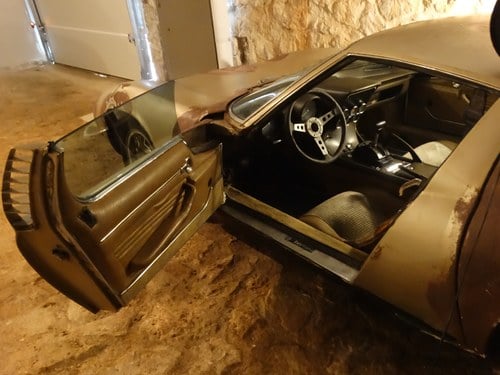
Chassis 4389 was produced in Bianco Miura over Gobi Beige interior to be delivered to Gerino Gerini’s Milan-based Lamborcar on January 23rd 1970. In 1978 it was imported in Greece to be cherished by a young newly wed couple of enthusiasts. Away from the public view, the couple would occasionally enjoy the Miura over the long stretches of the 140 km road to their summer house in Naflion resort. A decade later the Miura was resprayed in Oro Metallizzato before being stored in 1991 due to closing of Lamborghini’s local representative and a knee condition preventing comfortable clutch engagement. A year later the couple decided to respray the body and send the engine/ gearbox assembly to Sant’ Agata for total overhaul, a task that was never completed. After 34 years of storage and 48 years of ownership the family has decided to offer the Miura to an enthusiast. Unlike most Miuras in the market, this has never been restored, exhibited or auctioned allowing for total restoration at any level desired and any reputable facility including the world’s most credible Lamborghini’s own Polo Storico.
Specifications
Year: 1970
Date delivered: January 23rd, 1970
Lamborghini agent: Lamborcar, Milan, Italy
Make: Lamborghini
Model: Miura S
Tipo: P400XN560
Chassis number: 4389
Production number: 460
Bertone body number: 560
Engine number: 30465
Engine type: 3929cc, aluminum alloy block, 12 cyl. in 60 degree V config., quad cam DOHC, quad Weber 40 IDL 3C 3-barrel carburetted, 365 bhp at 7700 rpm 387 Nm at 5500 rpm output
Exterior color: Bianco Miura (currently Oro Metallizzato)
Interior color, trim: Gobi Beige, vinyl/ cloth inserts
Registration: Greek
Ownership history:
1972-1978: n/ a
1978-present: private