

Description
499cc Single | Clubman Specification | 598 PMK | Electric Start | Exceptional History File
There are old motorcycles, and then there are motorcycles which seem to contain an entire era within them. The BSA Gold Star belongs firmly in the latter camp.
Its recipe sounds almost comically simple today: one cylinder, one carburettor, two wheels and very little else. Yet for a generation of British riders, the Goldie was the motorcycle to have. The machine you raced on Sunday, rode to work on Monday and discussed at exhausting length in cafés for the rest of the week.
And if you wanted the ultimate road-going version, you wanted a DBD34 Clubman.
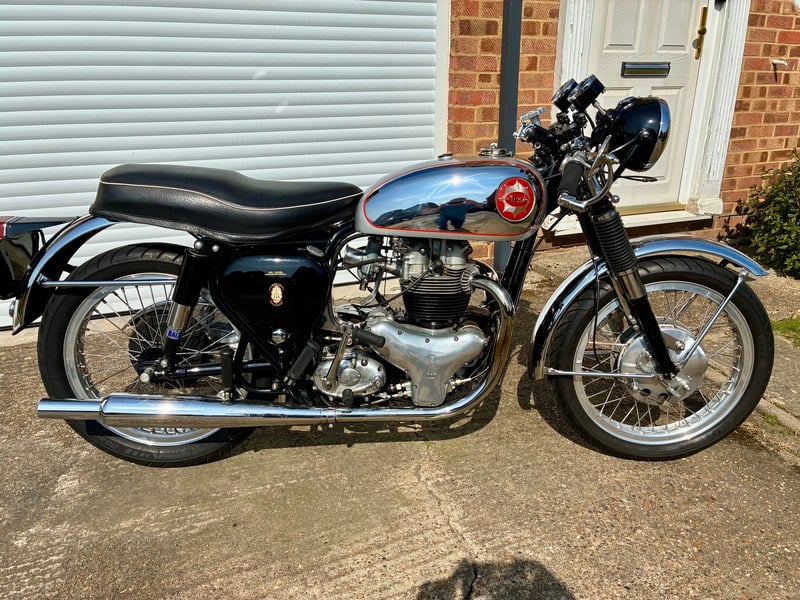
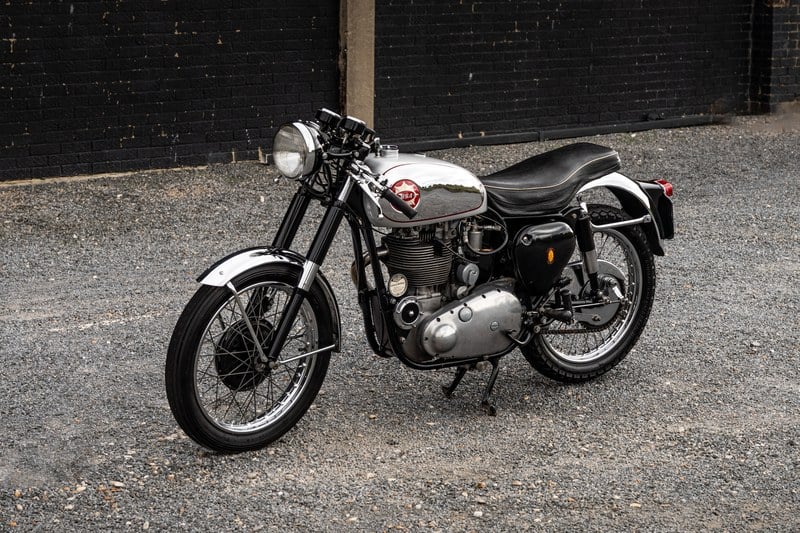
This is 598 PMK, a beautifully presented 1958 BSA Gold Star built around a genuine factory Clubman-specification frame, powered by a genuine 1958 DBD34 Gold Star engine and accompanied by the sort of history file that can make an enthusiast disappear for an afternoon.
It also has an electric starter. But more on that later.
The Goldie
The Gold Star story famously began at Brooklands in 1937, when Wal Handley lapped the banked Surrey circuit at more than 100mph on a BSA and earned one of the circuit's coveted Gold Star awards. BSA knew a good name when it saw one.
By the post-war years the Gold Star had evolved into one of Britain's definitive sporting motorcycles, offered in 350cc and 500cc forms and in specifications ranging from touring to trials, scrambles and racing.
These weren't merely motorcycles styled to look competitive. Gold Stars were built with competition very much in mind. Customers could specify engine tune, gearing, tanks, exhausts and wheels, while individual engines were tested and supplied with performance documentation. They became devastatingly successful.
At the Isle of Man, Gold Stars became so dominant in Clubman's racing that by 1955, 33 of the 37 starters in the 350cc Junior Clubman's event were riding them. The following year the Clubman's classes disappeared altogether. By then BSA had introduced what many consider the ultimate Gold Star: the DBD34.
A 499cc alloy-engined single, breathing through a large Amal GP carburettor in Clubman trim, driving through a close-ratio gearbox and clothed in little more than a chrome-sided tank, low clip-ons and black cycle parts. No fairings. No electronics. No excuses.
The result was one of the fastest and most charismatic road motorcycles of its generation, capable in appropriate trim of somewhere around the ton. Sixty-eight years later, its proportions still look right.
598 PMK
The really interesting part of this particular Goldie's story starts when you open its history folder.
Its BSA Owners' Club Dating Certificate, issued in April 2022 from the surviving factory records, identifies frame CB32. 7338 as having been manufactured in 1958 and dispatched on 14 March 1958 as a 500cc B34 Gold Star in Clubman specification to Bob Keeler Ltd of Wembley, Middlesex.
The fitted engine, DBD34GS. 3316, is also a genuine 1958 500cc B34 Gold Star unit, originally belonging to a machine dispatched to Eleanor Motors of London E8 on 2 April 1958.
Both its frame and engine are independently documented period Gold Star components, and both have meaningful provenance.
The history file even contains a wonderful period BSA Model B34 Gold Star Brake Test document bearing engine number 3316, identifying the specification as Clubman's, with Grand Prix carburettor and Magdyno ignition. The sheet records testing in March 1958.
It's the sort of fragile old piece of paper which arguably tells you more about the motorcycle than another hundred photographs ever could.
Seven Thousand Miles and Six Decades of Paperwork
The odometer shows a little over 7, 000 miles and, unusually for something born while Harold Macmillan was Prime Minister, there's documentation supporting its remarkably sparing use over decades.
The history records the engine's 1958 brake test at zero miles, followed by period MOT documentation showing 2, 303 miles in 1975, 3, 692 in 1976/ 77, 4, 434 in 1978, 4, 823 in 1979, 4, 904 in 1980, 5, 221 in 1984, 6, 074 in 1985, 6, 357 in 1986, 6, 517 in 2008, 6, 695 in 2009 and 7, 027 in 2012.
There is also a wonderfully bureaucratic 1984 Department of Transport Vehicle Licence Application for registration 598 PMK, describing the motorcycle as a BSA of 499cc and recording its then keeper, Stuart Malcolm Lee of Watford. Mr Lee's name crops up repeatedly throughout the file, providing a pleasing thread of long-term ownership and maintenance.
In August 1983 he sent the magneto to vintage electrical specialist Dave Lindsley, who stripped it and reported that it required an overhaul with new points, winding, condenser and slip ring. The accompanying September 1983 invoice records the completed work.
Nearly four decades later, the same specialist name appears in the file again: another documented Lucas MO1L magneto overhaul by Dave Lindsley in September 2022, at a cost of £474. Few history files provide quite that sort of continuity.
Elsewhere there is a 2011 Hawker Electrical invoice for a Lucas E3LM dynamo rebuild kit, while paperwork from motorcycle paintwork specialist Lewis Templeton records work/ quotation relating to the Gold Star's chromed, painted and hand-lined fuel tank in 2007.
This isn't a newly assembled motorcycle accompanied by a freshly printed folder. It has history.
The Button
Now to that electric starter.
Traditional Gold Star starting procedure has always formed part of the folklore. Find compression. Ease it just beyond. Retard the ignition. Tickle the carburettor. Position the piston. Commit.
Get it right, and you're rewarded with one of motorcycling's great noises.
Get it wrong, and you've provided entertainment for everybody outside the pub.
A previous custodian decided that authenticity was wonderful, but occasionally a starter button is even better.
In October 2023, more than £2, 260 was spent with BSA Goldstar Parts on a properly engineered electric-start installation. The invoice records an electric starter kit incorporating a modified original inner case, oil-seal sliding plate with bolts and gaskets, new Regina primary chain, electrical components, complete LED bulb set and associated engineering labour.
Better still, the file contains detailed correspondence concerning the conversion: chain-case modification, clutch and engagement mechanism, electric motor, charging system, battery specification, maintenance, starting procedure and the practicalities of the installation.
The machine therefore retains the wonderful mechanical theatre of a big British single without necessarily requiring its owner to perform the traditional Gold Star starting dance every time there's an audience.
Purists may disapprove. They are welcome to use the kickstarter.
Recent Work
The motorcycle has continued to receive attention rather than simply becoming an ornament. The aforementioned Lucas magneto was professionally overhauled in 2022. The electric-start system and associated electrical improvements followed in 2023.
Most recently, in April 2026, RDS Motorcycles investigated a fuel leak. The float needle valve was found worn and was replaced together with its gaskets, while contamination trapped within the carburettor float chamber was cleaned out.
That inspection also noted internal corrosion/ debris within the fuel tank and recommended that the tank be refurbished internally. We mention it because old motorcycles don't become better by pretending their imperfections don't exist.
Cosmetically, the Goldie presents extremely well, retaining all the visual ingredients that made the Clubman one of the great British motorcycle shapes: chrome-panelled tank with its red Gold Star badge, black cycle parts, alloy engine, narrow bars and that wonderfully purposeful stance.
The Paperwork
Perhaps the greatest pleasure, aside from actually riding it, is the extraordinary quantity of material accompanying 598 PMK.
There is the BSA Owners' Club factory-record dating certificate; the period BSA brake-test documentation for engine 3316; historic MOTs and mileage records; old licensing paperwork; correspondence; decades of electrical invoices; dynamo documentation; paintwork records; the substantial electric-start conversion invoice and technical notes; recent workshop invoices; and a collection of historical and technical Gold Star material.
There is even paperwork recording the motorcycle changing hands through Cosmo Classic Motorcycles for £15, 000, identifying registration 598 PMK together with frame CB32. 7338 and engine DBD34GS. 3316.
For anyone who believes the documents are half the pleasure of owning an old machine, there's plenty here to keep a winter evening occupied.
Specification
Make: BSA
Model: Gold Star DBD34 Clubman
Year: 1958
Registration: 598 PMK
Engine: 499cc air-cooled OHV single-cylinder
Frame: CB32. 7338
Engine: DBD34GS. 3316
Frame specification: Factory-documented 500cc Gold Star, Clubman specification
Engine provenance: Factory-documented 1958 500cc B34 Gold Star unit
Carburation: Amal GP / Grand Prix type
Gearbox: Close-ratio four-speed
Starting: Traditional kick-start plus professionally installed electric starter
Electrical system: Upgraded to 12V as part of the electric-start installation, with LED bulbs
Indicated mileage: circa 7, 000 miles, supported by extensive historic mileage documentation
History: Exceptional accompanying archive dating back decades
598 PMK is the Gold Star for somebody who wants to understand what made these machines so special — and then actually use one.
Its frame left BSA in 1958 as a genuine Clubman-specification Gold Star. Its DBD34 engine is itself a documented 1958 Gold Star unit and remarkably retains period BSA test documentation bearing its number. Its registration and mileage are supported by paperwork stretching back decades. Its maintenance history includes some of the same specialist names appearing forty years apart.
And somewhere along the way, somebody had the wonderfully sensible idea of fitting an electric starter.
A café racer from before café racers became a fashion statement.
A machine born from competition rather than marketing.
And still, after nearly seven decades, one of the best-looking ways of turning petrol into noise.