Description
It was in a geopolitical situation comparable to what we are experiencing today (oil rationing following the Suez Canal crisis in 1956) that the British Motor Corporation decided to design a new economical car: the prototype of the future Mini was born in October 1957, with a small front-mounted 850 cc engine in transverse position allowing 80% of its length to be dedicated to its occupants and their luggage. The definitive car was launched in 1959 under the names Morris and Austin.
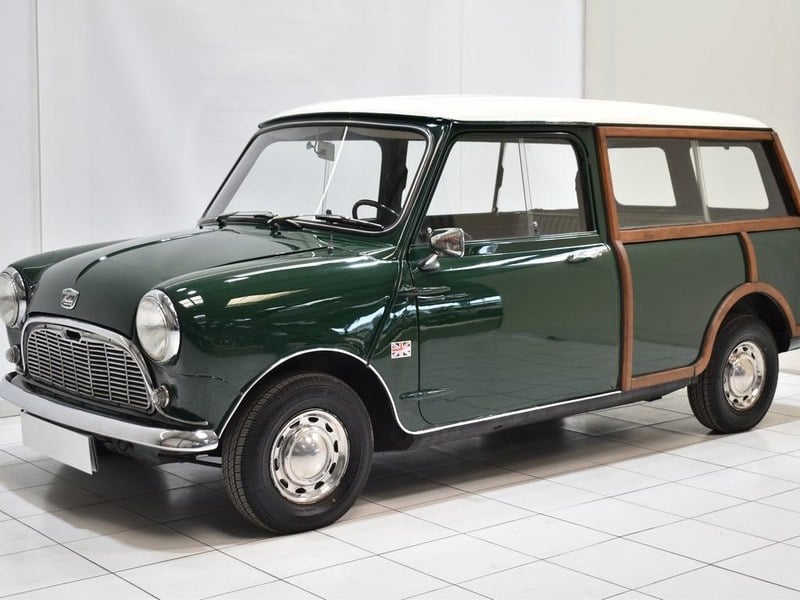
In 1960 a longer version intended for families and small business owners arrived under the name Austin Mini Countryman. The idea remained to preserve the Mini's compactness whilst offering greater load capacity. But it was in 1961 that the marque really made the model stand out with the appearance of the "Woodies" versions: the Countryman received exterior ash wood panelling in varnish that framed all the rear parts of the vehicle. Even though versions without panelling (which are purely decorative) exist, the woodies remain the most sought-after: the contrast between the small bodywork and the wood panelling giving the car a most charming singularity.
Becoming a true icon throughout the sixties, it followed the evolution of the "classic" Mini and evolved into the MK2 in 1967 with new grille, new lights, new 998 cc engine and so on... The year 69, celebrated by Gainsbourg and Birkin (a great enthusiast of the Countryman), marked the end of this woody-styled Mini which immediately entered into legend.
This is indeed the model from this final year of production that we present to you, as it was delivered new on 20 August 1969 at Beuvens in Charleroi. It was first registered in France on 19 October 1978 and has never left the hexagon since. Offered in a very chic coordinated almond green interior with matching trim enhanced by a beautiful varnished wood dashboard, this Countryman is absolutely delightful. We have certificates from the FFVE and the Mini France club certifying that this is indeed an MK2. Note three modifications compared to the original factory specification:
. An MK1 grille (more elaborate) and not MK2
. A cream roof (for greater contrast) and not GN37 Almond Green for the entire vehicle.
. A bucket-style driver's seat rather than the original, the original being supplied as well (Note that the upholstery is new).
We have an extensive file of maintenance and restoration invoices, notably from the specialist "My Mini Revolution" totalling over 12, 000 euros.
A bespoke high-quality cover with piping is provided.
The last oil change service has just been carried out by a local specialist.
Thus it is a true English icon, with an inimitable and totally irresistible style, equally at home in the countryside as in the most chic Parisian neighbourhoods, that we propose to you, a car that reminds us of "the ex *** of the sixties"...