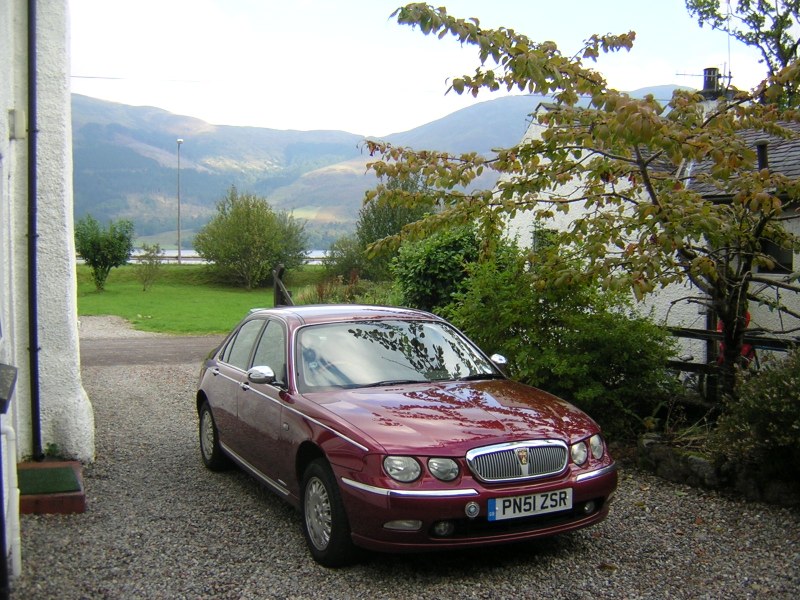
Description
Offering a very rare and non existent rover 213s fitted with the more desirable Honda engine the car is in very good order the car has very nice black paintwork all-round flawless interior with no wear fabulous roof lining superb drive quality an has only covered just 81000 miles originally belonging a vicar who has kept the car in very nice order.
The original Rover 200 (sometimes referred to by the codename SD3) was the replacement for the earlier Triumph Acclaim, and was the second product of the alliance between British Leyland (BL) and Honda. Only available as a four-door saloon, the 200 series was intended to be more upmarket than the company's Maestro and Montego models, which the 200 Series came in between in terms of size. It was launched on 19 June 1984, at which time there was still a high demand for small family saloons, with many manufacturers selling this type of car under a different nameplate to similar-sized hatchbacks. For example, Ford was selling the saloon version of the Escort as the Orion, the saloon version of the Volkswagen Golf was called the Jetta, and Vauxhall would soon launch an Astra-based saloon called the Belmont. The Rover 200 Series, however, was not based on a hatchback.
Earlier in 1984, Austin Rover had confirmed that the successor to the Acclaim would be badged as a Rover rather than a Triumph – a decision which signalled the end for the Triumph brand. The move was seen as controversial as the Rover brand had long been associated with large executive saloons as well as the Land Rover and Range Rover, and there were fears that its application to a small Japanese-derived compact would devalue the Rover name.
Essentially, the 200 series was a British-built Honda Ballade, the original design of which had been collaborated upon by both companies. Engines employed were either the Honda Civic derived E series 'EV2' 71 PS (52 kW; 70 bhp) 1. 3-litre 12-valve engine, or British Leyland's own S-series engine in 1. 6-litre format (both in 86 PS (63 kW; 85 bhp) carburettor and 103 PS (76 kW; 102 bhp) Lucas EFi form). The resulting cars were badged as either Rover 213 or Rover 216.
The 213 used either a Honda five-speed manual gearbox or a Honda three-speed automatic transmission. The British-engined 216 also employed a Honda five-speed manual gearbox, unlike the S-Series engine when fitted in the Maestro and Montego. There was also the option of a German ZF four-speed automatic on some 216 models as well.
The Honda-badged version was the first Honda car to be built in the United Kingdom (the Honda equivalent of the 200 Series' predecessor, the Triumph Acclaim, was never sold in the UK). Ballade bodyshells, and later complete cars, were made in the Longbridge plant alongside the Rover equivalent, with the Ballade models then going to Honda's new Swindon plant for quality-control checks.
Although production ceased in late 1989, stocks of the car continued to be available until early 1990, when it was replaced by the Rover 400.
This model of car (SD3 saloon version; 216S in the first series, then replaced by a 216SE EFi model) is well known as Richard and Hyacinth Bucket's car in the BBC Television sitcom Keeping Up Appearances (1990–1995).