
Description
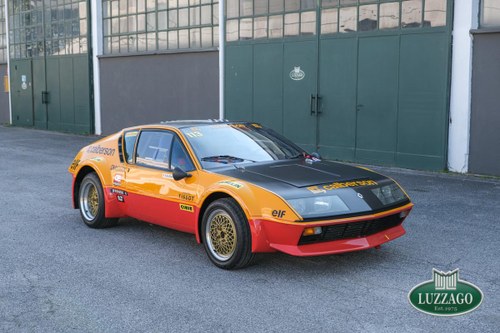
Former racing car now homologated for road use, overhaul performed until October 2025. Possibility of updating the registration book with 15" wheels. Built 03 November 1978 (with certificate issued by Alpine Dieppe). First registered in Germany and then imported to Italy in 1990. Still regularly registered today. From 2012 to 2020 the car underwent a complete restoration and preparation to compete in motor racing. During the preparation, every component was dismantled and replaced or overhauled. When the restoration was completed in 2020, the engine was run in for only 300 km. The Calberson livery was chosen in honour of the 1977 European Rally Championship victory with driver Guy Frequelin. The details follow in alphabetical order. At the end of its preparation it obtained the ACI SPORT HTP for road races, hill-climbs and rallies. You will also find the complete story described in detail in the November 2018 issue of Automobilismo d'Epoca. HABITACLE Five-point seat belts and sports seats were installed. The type approval has expired. There is also the navigator's foot plate, navigation light and the rear seats contain the battery in an airtight container. GEAR AND SELFLOCKING The 4-speed gearbox model 369 has been removed and a 5-speed UN1 gearbox has been installed (the same one used by the Renault 5 turbo).
All the gears of the gearbox and differential were made new by PRINA INGRANAGGI: this is a close-ratio gearbox with self-locking (the ratios are those defined in the fiche). Nb. Until mid-1979, the chassis of the Alpine A310V6 did not foresee the installation of the UN1 gearbox. For this reason, the UN1 gearbox did not physically fit in the chassis of the 1978 Alpine A310 V6. It was therefore necessary to modify the chassis and to study and build an ad hoc linkage. BODYWORK A group 4 kit was installed to widen the mudguards and the rear blinds to allow the free circulation of heat from the engine compartment. The kit was purchased from Simon-Auto. de It was then decided to colour the car with the Calberson livery with which Guy Frequelin won the French rally championship in 1977 (beating Darniche in a Stratos).
The red and black threads are not stickers, but are layers of paint. Small colour note: the autographs of Darniche, Merzario and Chicco Svizzero can be seen on the bodywork. POWER PLANT The double petrol pump has been installed. An intake manifold has been made to fit the 3 WEBER DCNF 42 double-bodied carburettors (WEBER original at the time, not the modern ones). ELECTRICAL SYSTEM The whole system is new. The relay and fuse box is in sight and within easy reach of the navigator. The light switch is new. EXTINGUISHING SYSTEM An electronic extinguishing system with a fixed fire extinguisher mounted in the rear seats has been installed in the passenger compartment and in the engine compartment. There is also a hand-held fire extinguisher in the passenger compartment. BRAKING SYSTEM The original pedals have been removed from the passenger compartment.
All the car's brake hoses were replaced with braided hoses (completely, from the master cylinder to the caliper). The handbrake is not hydraulic because it is not included in the fiche. With regard to the brake calipers, we had initially fitted those of the Renault 5 Turbo at the front and left his at the rear. When we tested the car, however, we felt better with the Cosworth brakes at the front, so these are now fitted. HYDRAULIC SYSTEM All the original pipes have been replaced with silicon pipes (connections to the engine and radiator). The radiator has been replaced with a larger aluminium one. The passenger compartment heating system has been retained. EXHAUST SYSTEM The exhaust manifolds are made of steel and have been covered with a heat shield.
The silencer is made of steel and is not approved for road use. ENGINE The engine is the PRV 2, 664 cc as required by regulations. A new engine was purchased, never used. It was opened, the piston rods were replaced, mondial pistons machined by Paul Condrilles at the time were installed, all the linkage was lightened (connecting rods, shaft,..). The heads were replaced thanks to the fact that we found two heads machined by Paul Condrilles at the time. Valves, springs, ... everything was prepared to run up to about 7200 rpm. The cammes were made new according to the required specifications to have 200hp at about 6000 rpm and a maximum torque of 240Nm just above 3700 rpm. An electronic rev-limiter was also fitted. WHEEL HUBS ? WHEELS - PNEUMATICI The car was originally fitted with 3 bolts. The fiche allows the use of 4 bolts (Renault 5 Turbo type). For this reason, 4 new wheel hubs in C45 steel with 4x98 coupling have been studied, designed and machined from solid steel. The rims are decomposable, made by NORI at my request to have the central flange of 15? with BBS design. The channels should be 7" at the front and 9" at the rear. The car is currently fitted with 205* 50/ 15 at the front and 225* 50/ 15 at the rear. I also have the Renault authorisation to homologate them on the car's registration. ROLLBAR (SAFETY CAGE) The car is fitted with a cage made by SASSA ROLLBAR with FIA certification. As detailed later in the CHASSIS section, the safety cage is anchored to the subframe under the cockpit and to the rear domes.
SUSPENSION EIBACH springs and SPAX shock absorbers have been installed. All tie rods have been revised and all powerflexes are new. CHASSIS The chassis has been completely sandblasted and powder-coated. The domes have been rebuilt and reinforced. At the base of the fibreglass cell, a subframe has been built to support the rollbar (so the safety cage does not rest on the fibreglass as is often the case on Alpine A110s, but rests on a dedicated metal structure). The complete chassis weighs 135 kg. SIDE GLASS WINDOWS Plexiglass windows with ventilation opening were made ad hoc. Note the fact that they are not straight but curved, so their construction was not trivial.