Description
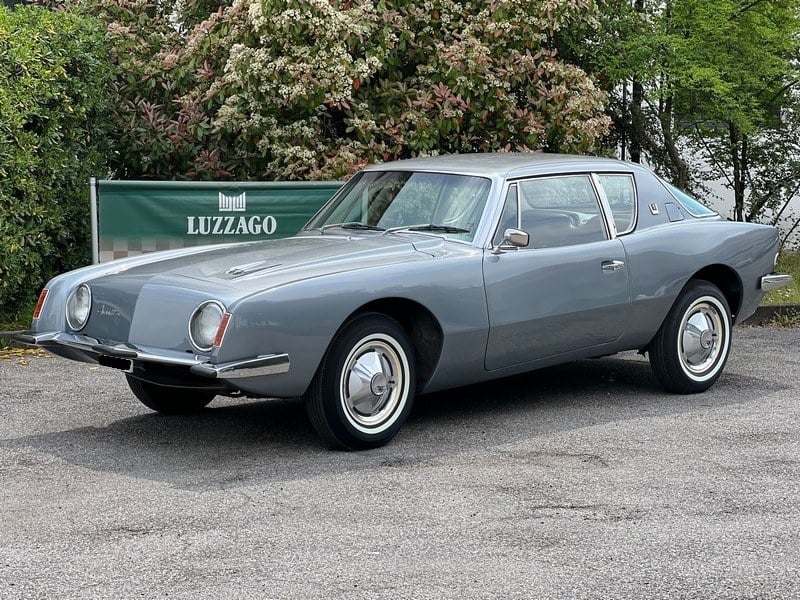
It was designed by a team of engineers led by renowned industrial designer Raymond Loewy, who, among other things, had designed vending machines and other sales equipment for Coca-Cola. The resulting project featured a completely new aesthetic and radical design.
The Engine
The body was made of fiberglass-reinforced polyester. Beneath this surface, however, due to Studebaker's financial situation, the chassis of the 1953 Studebaker Lark Daytona remained the basis. The available engine was the 4, 737 cc Studebaker small-block V8, fed by a four-barrel inverted Stromberg carburetor, in either naturally aspirated (Jet Thrust) or supercharged (with a McCulloch single-stage centrifugal supercharger) versions. Power output ranged from 235 to 260 hp (SAE). The car was very similar in size to the Ford Mustang, and the supercharged version could accelerate from 0 to 60 mph in under 8 seconds and reach a top speed of over 150 mph.
Only 4, 643 were produced before Studebaker closed its South Bend plant. The Avanti's history, however, didn't end with Studebaker's exit from the automotive market. Two of its South Bend dealers, Nate Altman and Leo Newman, purchased the Avanti brand, the molds, all remaining parts, the tools, and even a portion of the factory to continue production. Eugene Harding, a former Studebaker engineer, also collaborated with them.
A 1967 Studebaker Avanti II
Thus, the Avanti II was born. Equipped with a 5. 4 L (327 in³) naturally aspirated Chevrolet Corvette engine, much lighter than its predecessor, the car was built entirely by hand. From 1966 to 1975, only 909 examples of the car were produced.
In the early 1980s, the Avanti company was purchased by Stephen Blake. The car was equipped with a more modern chassis with independent suspension, and a convertible model was also produced. Blake's company, however, declared bankruptcy in 1986. The company was then purchased by Michael Kelly, who moved production to Youngstown, Ohio. The new company continued selling the Avanti until approximately 1991.
After that, there were further attempts to revive production of the Avanti, and it appears that spare parts for these cars were produced until 1999.