Description
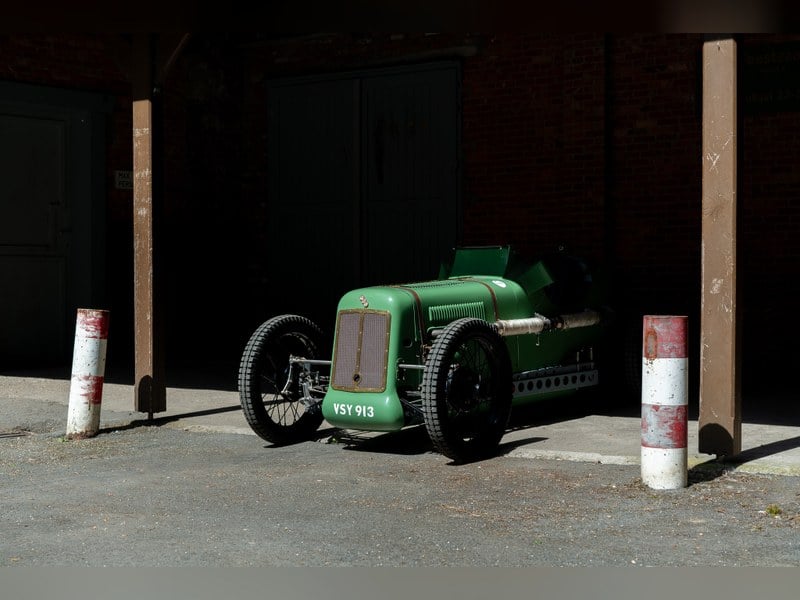
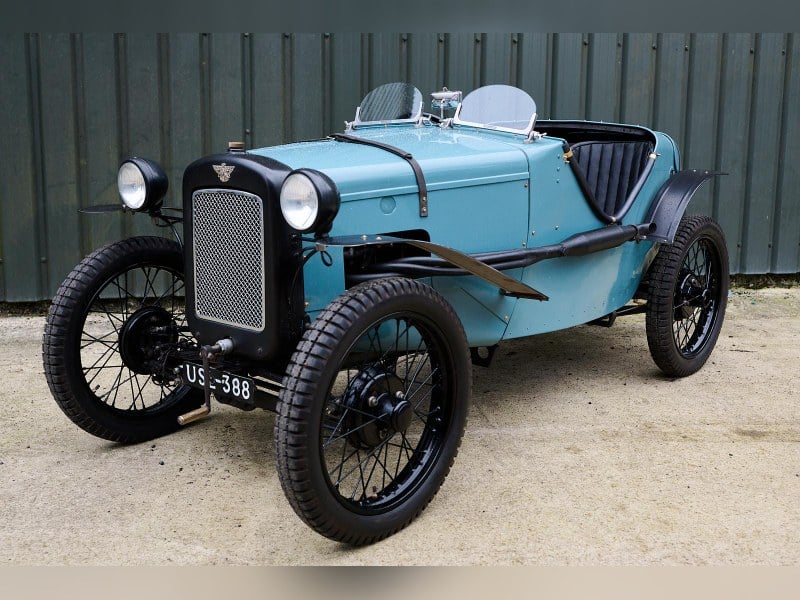
Kelham Hall | Newark, Nottinghamshire Viewing: Tues 22nd September 2026 from 12pm Auction: Weds 23rd September 2026 12pm Location: Kelham Hall Main Street, Newark, Nottinghamshire NG23 5QX Registration No: Un-RegisteredChassis No: 156480MOT: Exempt Built in period by Bill Williams (of Cambridge Engineering fame) for R. R. Willis Competed in pre- and post-WW2 hill climbs and sprints at venues including Prescott and Shelsley Walsh 1932 long chassis fitted with a Pigsty Racing supercharged 1928 magneto engine, mated to a four-speed gearbox In regular competition use with recent owners including the vendor Supplied with extensive history including correspondence from Bill Williams and VSCC buff forms Spurred on by the introduction of the horsepower tax in 1921, Sir Herbert Austin began working on the concept of a small family car despite opposition from the company’s board due to their being in receivership at the time. Undaunted, Sir Herbert engaged the services of a young draughtsman from the Longbridge plant, eighteen-year old Stanley Edge, and plans were drawn up in the billiard room of his house, Lickey Grange. Having invested a large amount of his personal money into the project and being responsible for much of the car’s styling, Sir Herbert was able to claim a royalty of two guineas on each car built. Initially powered by a sidevalve four-cylinder engine of 696cc with a detachable cylinder head, the new model was rated at 7. 2 horsepower but was almost immediately enlarged to 747cc and 7. 8hp. Some 2, 500 examples were produced in 1923 and just a few years later the little Austin had transformed the fortunes of the parent company. By the time production ceased with the advent of war in 1939 some 290, 000 cars and vans had been produced. The Willis Special ranks among the most important and historic non-works racing Sevens. It was constructed during 1937 by L. M. “Bill” Williams who in 1932 had founded Auto Conversions in Willesden. He built sprint and hill-climb Austins for himself and also for customers, and the Willis Special was produced for R. R. Willis using a 1932 long chassis (6ft. 9in.), Ulster-type eight-stud engine, a three-speed gearbox with Ulster close ratios, and a standard saloon rear axle. The period specification further included a Thetis magneto conversion with a Scintilla magneto, an Arnott supercharger, an Auto Conversions wide front axle, standard suspension parts, standard brakes, and Salmson steering. As Williams had no employees at the time, he produced the hand-beaten aluminium body himself in one piece from nose to tail, with the headrest section riveted on. In a 1962 letter, Williams recalled: “This car I admit to building for a client in the late thirties and was built as such to accommodate his 17-stone weight. This car I ran in conjunction with the owner; I being much lighter always made better times in club sprints and hill climbs, so we did not come home empty-handed, both having a go. The car we tuned on the Brooklands track but found that for distance racing it was not well-suited as overheating always took place, so we confined it to sprints and hill climbs. “This was the only car which has been invited to compete as a team with the works camshaft cars in a hill climb. The racing manager rang me up after we had entered our car and explained that the Kay Petre sidevalve car was so badly smashed that they had given up any hope of repairing it, and as their entry for three cars was already in, would we combine with them. This we did, but unfortunately the gear lever broke in half on the first run with my client driving and put us out of the picture. “The car was always towed to the various meetings, which entailed early morning kick-off, with some very wet long rides with a late return utilising the benefits of crash helmet and visor… “The client I built the car for did not have much success with it, mainly as he admitted he was too heavy and a little ham-handed in its control, whereas, when I ran it, I held my own in every event against MGs, Frazer Nashes, etc.” Stuart Ulph, author of Would Suit Enthusiast: L. M. Williams and His Austin Seven Specials, described the car in detail and added: “The body was mounted on a 1932-type long chassis, number 156480. For most of the car’s life, [the engine] was M132391, although the pressurised crank and rods are from a blown engine, number 142501.” The works Shelsley trip referred to by Williams was on May 28th, 1938. Other documented appearances for the Willis included the inaugural Beechwood sprint on June 26th, and a Prescott meeting on July 3rd, where it apparently set a time of 59. 52s. The wartime history is murky, but Williams recollected that it had gone to the Channel Islands and been used for local hill climbs, before he bought it back. “After an overhaul and repaint,” he added, “it went to Ireland and was used there in club events.” In 1941, Auto Conversions moved to Cambridge Road, Kew, and became Cambridge Engineering. An...