Description
With its monocoque body, four-wheel brakes, independent front suspension and V4 overhead camshaft engine many enthusiasts view the Lancia Lambda as one of the great automobiles of all time. With a conventional pedal layout and H-pattern gear selection the Lambda also set the automotive template for years to come.
The Lambda was also successful in competition with privately entered cars finishing fourth and fifth behind the works OMs in the first Mille Miglia of 1927.
Lancia continually developed the Lambda through nine series of cars with the 8th and 9th series receiving a larger 2, 570cc engine and four-speed gearbox.
Chassis no: 20360 was first registered (GF 5687) in 1930 as a standard four-door saloon as confirmed by an original letter dated July 1947 from the Lancia Works, Alperton to the car’s then owner.
Sometime after 1933 the Lambda was owned by John Fotheringham-Parker, brother of racing driver Philip Fotheringham-Parker.
The Fotheringham-Parker brothers rebuilt a number of Lambdas before the war with much of the work being carried out by West & Chittenden, the go-to Lancia specialists of the time. West & Chittenden were based in Queens Gate Place Mews, London and were known for their improved Lambda engines.
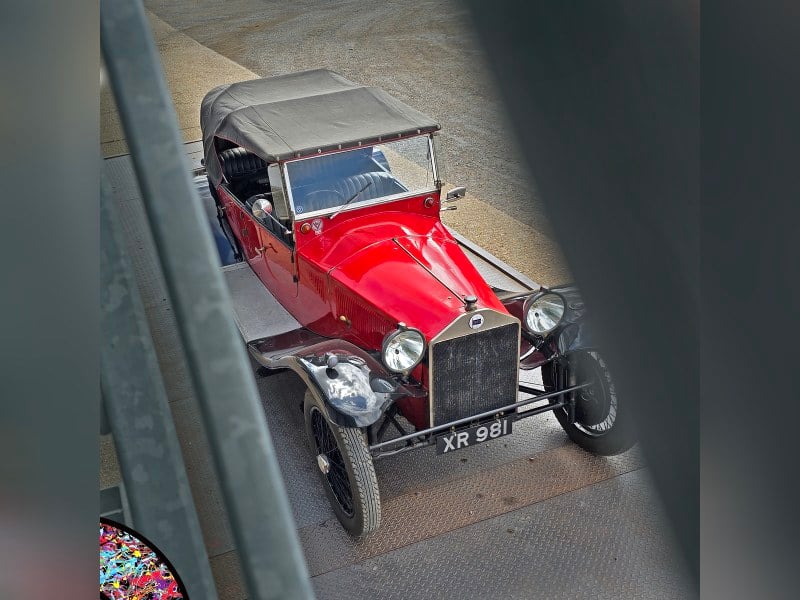
The Fotheringham-Parkers fitted a two-door open tourer body to 20360 and had West & Chittenden rebuild the engine with a lighter flywheel, special conrods and pistons, lightened valve-gear and raised compression. A letter from Bob West (of West & Chittenden) dated July 1948 is on file and confirms the car was modified with a tubular propshaft, a Stromberg downdraft carburettor and a stop fitted to the clutch. West also confirmed the car was a ‘very fast example of its type’. The Lambda was re-registered on the 4th July 1938 to FKE 733, the number it retains to this day.
In 1948 later owner Geoffrey Wilde of Derbyshire corresponded with Philip Fotheringham-Parker and in PFP’s own words ‘the car competed with considerable success at Brooklands, Crystal Palace, Donington and many trials and hillclimbs – the best lap speed at Brooklands being well over 90 mph’. A period photograph of the car taking part in a trials event in the Winter of 1938 is on file.
Fotheringham-Parker sold the Lambda just prior to World War II to fellow racing driver David Alan Hampshire of Derbyshire. Hampshire raced a Maserati 6CL from 1939 at Brooklands, Crystal Palace and Donington and in 1947 competed in Derby-based racing driver Reg Parnell’s ‘The Challenger’ and ERA. Hampshire sold the Lambda to Geoffrey Wilde in 1947.
In a letter dated September 1976 Wilde details the car’s history to its next owner Stanley Hodgkinson of Penrith. In 1950 Wilde commenced a refurbishment program which was carried out by the Lancia Works in Alperton, London. Multiple correspondences and invoices from Alperton are on file which detail the works carried out.
The original engine was overhauled with a rebore, new pistons and reprofiled camshaft. The cylinder head was replaced as the original was cracked and the oil and water pumps rebuilt. The radiator matrix was replaced and the car was completely rewired.
The brakes, steering and wheel hubs were also overhauled by Lancia Works along with the installation of new shock absorbers and front and rear springs.
Wilde also fitted new bonnet sides which were fabricated to his own drawings. The windscreen, hood and side-screens were replaced and the body was repainted from black to red by Docker Brothers of Birmingham. Apparently the red colour (Poppy 4849) was matched from a berry!
In 1982 the Lambda was acquired by the Baxter family who displayed it in their Liverpool car museum for over thirty years.
Today this special Lambda is offered for sale in good condition and in good running order. Crucially it retains its original engine and gearbox, a real rarity amongst Lambdas.
The car is also accompanied by a history file containing period correspondences from previous owners, original invoices (including many from Lancia Works Alperton) and a Lancia Lambda handbook.