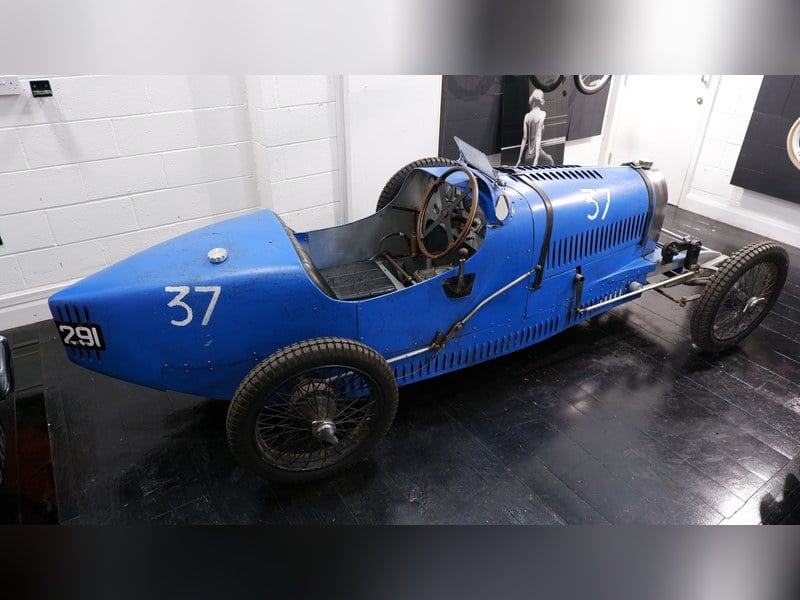

Beschreibung
Dutch title
Chassis 4451 (see text)
Engine 25
- Ex-Jo Siffert
- In the former ownership of the Dutch Bugatti Club President
- Untouched car since the 40's, well maintained
- One of just two Sicilian Type 35s to have survived
Italian History
The car on offer was discovered in Sicily at the start of the 1940s. All the available evidence leads us to believe that the car had until that point spent its entire life in the south of Italy.
This car is fitted with an original chassis plate, re-stamped 4491 over the number 4451, with a 9 engraved over the still visible number 5. The cars corresponding to these two numbers were both Type 35s that were delivered new in Italy in the Spring of 1925:
- Chassis 4451 (with engine 25) was delivered on 21 March 1925 to Bianchi, 5 via Muratori in Milan.
- Chassis 4491 (with engine 34) was delivered on 13 May 1925 to Michele Baccoli, from Milan.
These were the two Milan agents for the marque.
An inspection of the vehicle in its current configuration, untouched since the 1930s, has provided valuable information that we can now report:
- The chassis is an original Type 35 chassis, without supercharger, and dates from the spring of 1927.
- The engine bears the number 25 on the lower section of the case, which corresponds to chassis 4451.
- The chassis number 4451 is also engraved on the same part of the engine; it has simply been re-stamped with a 9 over the 5, and now reads 4491.
- The style of letters used to stamp the number 4451 is the same as that used by the factory; 4449/ 27 has an identical style, the same as other original Bugattis.
- olsheim controlled the stamping on the lower crankcase of the vehicle with the numbers 4451 and 25. The two cases, as well as the gearboxe and the steering box, also show adjustment marks " 0 ", which suggests the fitting of new factory parts during the refurbishment of the vehicle. It is logical to suppose that this work would have been carried out around 1927, when a new chassis was supplied by Molsheim.
- The frame is engraved with the logo of the Saint-Denis manufacturer, and the original stamping of the assembly number indicates assembly in March or April 1927.
- Some of the mechanical elements of this Type 35 pre-date this restoration as the front axle bears the number 11 and the water pump displays number 12. The rear axle belongs to the very first model : it has, along with the strut (currently welded and not mounted), the number 2 and stroke ratio 14-54.
This must be the rear axle of the first Type 35, ex-Grand Prix de Lyon, chassis 4324, delivered in Italy to Count Masetti from Bagnano, who used the car until September 1926. This car disappeared around 1934, having been fitted with a Maserati engine by Luigi Premoli. For comparison, the rear axle from chassis 4326 is identical in its build and displays, along with the strut, the number 3.
We therefore find ourselves in the presence of a Bugatti Grand Prix with mechanical elements dating from 1924 - 1925, on a 1927 Type 35 chassis without supercharger.
It cannot be a Type 35A chassis, the production of which ceased in March 1927, or a chassis for a car with supercharger, as it has no trace of holes for a steering box set further back. A hole was made in the bulkhead for the support for a second spare wheel on the driver's side and there are signs of the attachment for the leather strap, high up on the body.
These elements suggest that the vehicle took part in one of the rare races that required a second spare wheel. Of these, the Targa Florio and the Mille Miglia are, in Italy, the most well known.
We have not been able to find a Type 35 without supercharger that was entered by an amateur Italian driver in the prestigious Targa Florio, but in the 1928 Mille Miglia, we found evidence of a team, Chiabbetti-Crosti, at the wheel of a Bugatti Grand Prix which could be our car. We have not been able to confirm this yet, but there are no doubt all kinds of wonderful historical discoveries yet to be made about the car presented in the sale.
We must note that in July 1928, chassis 4491 belonged to Ottavio Scherm, a driver from Catania, who took part in the Syracuse Cup on 27 May. The following year, he participated in the Tour of Sicily in an Alfa Romeo, while one of his acquaintances, a man named Spampinato de Syracuse, entered a Type 35 with wings, quite similar to our car. It is possible that, by 1928, the registration document for 4491 was already being used for 4451, but we have no proof of this.
A Sicilian youth
The last part of the puzzle that helped us piece together the history of this car, was the discovery on the cover of the cam box and on the petrol cap, of a name that, although partially erased, appears to spell " Guglielmo Costanzo ". This is the name of an owner of the vehicle, who held registration papers for chassis 4491, in 1934. Guglielmo Costanzo bought the car on 28 June 1934 from a lawyer from Catania called Antonio Garozzo, who had, in turn, bought it from Syracuse in September 1932. Costanzo appears in 1928 on the list of licences of international drivers, at the address 164 rue de la Liberté, in Catania. From that point, at the latest, we can assume that the Bugatti 4451 used the papers of 4491, following restoration of the vehicle by this mechanic. In correspondence in 2006, Corrado Cupellini confirmed that Costanzo was indeed a Sicilian mechanic. This information is important as it shows that he was a sufficiently well-known figure for Cupellini to note it and relate him to the history of the car. Two months after registering the restored vehicle, Costanzo sold it to two Catanian enthusiasts called Antonio Lombardo and Salvatore Scuderi, before the Bugatti left Sicily for the region of Cosenza in the north of Italy.
The Bugatti spent the war years in the region of Crotone. It was found in 1958 in Catanzaro and was bought by the Venturi brothers from Rome, who had been told about the Sicilian history of the vehicle.
Roman discovery
And so during the 1950s, the car found itself in the collection of the Venturi brothers in Rome. The collection housed other automobile treasures including another Bugatti, this one a Type 37 in original condition (chassis 37240). This car and the Type 35 then joined the garage of Count Giovanni Lurani, the friend and associate of Corrado Cupellini.
The historian Francesco Guasti tells us : " Franco Venturi was a renowned Roman collector who owned, amongst others, the ex-Nuvolari Alfa Romeo Monza. He had a brother called Fernando who survived him and who shared his passion for beautiful motor cars. In the documents we have been able to study relating to their vehicles, were registration papers for 4491 in the province of Catanzaro, in Calabria ".
The Bugatti was registered there in March 1941 in the name of Francesco Solanda, in Crotone, before being acquired by Giuseppe Viraldi, from Catanzaro, in September 1958. Shortly afterwards, the car joined the Venturi collection in Rome. On 14 September 1967, it was sold to Corrado Cupellini.
Cupellini advertised the car in MotorSport in May 1968 :
" Bugatti Grand Prix Type 35, Chassis 4491. Engine 25. Concours condition. $ 9500. Corrado Cupellini, Mazzini 30, Bergamo, Italy. "
In 2006 Cupellini wrote: " I bought this car with my friend Lurani from the Venturi Collection in Rome. Venturi told me that the car came from Sicily. We used it for a while and then I sold it to the Swiss driver Joseph Siffert who told me he gave it to his sponsor Rob Walker. "
We have been able to trace the invoice from Joseph Siffert's garage in Belfaux, dated 13 August 1968, signed by Cupellini : " Received, the sum of 13. 000 SFR, in payment for the vehicle, consigned to Mr Freddy STREIN. " Strein was an optician from Bern and a friend of Jo Siffert, who raced a Cooper Maserati.
When Rob Walker died, the car was sold at auction in March 1975 by Christie's in Geneva. The catalogue mentions a restoration by the mechanic of Count Lurani. The car was bought by the Dutch collector, Tom Meijer, from Wassenaar, before being bought by the current owner in 1985.
A story of chance and survival
Italy was a good customer for the Bugatti factory during the period 1920 - 1930, before the politics of the country led to the closing of borders. The Bugatti Grand Prix cars delivered between 1924 and 1930 took part in races and numerous events held around the country as far as Sicily. In addition to the mythical Targa Florio, these events included the Mugello circuit, the Coppa Etna, Mont Cenis, Madanella, the Coppa Montenero, the Coppa Perugia, the circuit del Garda... and the Mille Miglia !
Almost 100 Bugatti Grand Prix were delivered new in Italy between the end of 1924 and 1930. The survival rate is terrible: less than 10 cars survived !
The difficulty of the races and the lack of spare parts, no doubt due to the country's isolation after 1931, all contributed to this massacre. Of around 15 examples of the Type 35 delivered, just 4451 and 4698 have survived, and only one Type 35A of 14 sold. Of 15 supercharged Bugatti Grand Prix Type 35 B/ C exported to Italy, only two are currently conserved in collections. Of the 50 Type 37 and 37A examples sold in Italy, just one car, without supercharger, (which was also part of the Venturi collection : chassis 37240), and two Type 37A have survived. At the start of the 1930s, certain Bugatti Grand Prix had their engines replaced with Fiat or Maserati engines... and were used until they finally gave up, and were then scrapped. During the 1950s, the American Bugatti 'hunters' didn't appear to have good contacts in Italy and were unable to find and save these beautiful machines.
In conclusion
This Bugatti Grand Prix, in its 1925 configuration, spent the greatest part of its life between Sicily and the three provinces making up the heel of Italy : Cosenza, Crotone and Catanzaro.
We can assume that intensive use in competition during its early years, and probably a serious accident, led to the car being given a new chassis supplied by Bugatti in 1927. The car then continued its sporting career and is today still equipped with most of the parts from the period it was built (1925).
This Bugatti chassis 4451 is a survivor. It is also clear that it participated in numerous races in Sicily and in Italy. It must have undergone a few operations to have driven through the pre-war years in preserved, running condition. Although its history up to 1934 was certainly eventful and remains rather mysterious, its journey since it arrived in Catanzo in 1941 is clearer, with just two or three owners before it was discovered in the Roman collection of the Venturi brothers.
If we had seen this car in the streets of Catania or Catanzo in the post-war years, we would have wanted to follow it and possess it. The opportunity to do that has arisen today, and this beautiful, ageless machine is in perfect working condition, having been looked after for more than 30 years by a loving and thoughtful owner.
Photos © Guy Van Grinsven
For sale in our upcoming auction on November 5th in Paris.
1 000 000 € - 1 350 000 €
More photos of the car can be viewed at the following link: - details above