
Beskrivning
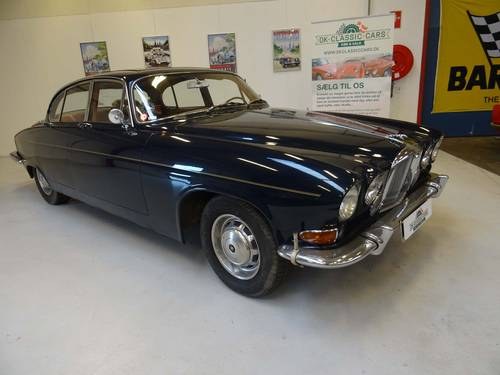
1963 Jaguar Mark X (Project)
Jaguar’s top-of-the-range saloon car. The car starts, drives and stop as it should. This is a left-hand drive car with an odometer in kilometers, making this a special car. The car has Danish registration papers.
Car specifications:
VIN/ Chassis number: 351861BW
Odometer: 65, 296 kilometer
Engine: 3. 8 liter, 6-cylinder, 265 horsepower
History of the Jaguar Mark X:
The Jaguar Mark X (Mark ten) was the top-of-the-range saloon car built by the British manufacturer Jaguar, primarily aimed at the United States market. The Mark X succeeded the Mark IX as the company's largest saloon model.
The Mark X was the first Jaguar saloon to feature independent rear suspension. It differed from earlier large Jaguar saloons in having 14" wheels instead of the more common 15". It used a wider-track version of Jaguar's IRS unit first seen on the E Type, which was subsequently used on Jaguar vehicles until XJ-S production ended in 1996. The front suspension used double wishbones with coil springs and telescopic dampers. The car initially featured a 3781 cc version of Jaguar's XK in-line six-cylinder engine. A 9:1 compression ratio was standard, but an alternative 8:1 compression ratio was available as an option. For the London Motor Show in October 1964 the enlarged 4, 235 cc unit took over, although the 3. 8-litre unit could still be specified until October 1965. Triple SU carburettors were fitted, fed from an AC Delco air filter mounted ahead of the right hand front wheel.
Transmission options were manual, manual with overdrive, automatic, or automatic with overdrive. The arrival of the 4. 2-litre power unit coincided with the introduction of a newly developed all-synchromesh four-speed gear box, replacing the venerable box inherited by the 3. 8-litre Mark X from the Mark IX, which had featured synchromesh only on the top three ratios. Many domestic market cars and almost all cars destined for the important North American markets left the factory with a Borg Warner automatic gear-box. The 4. 2-litre engine's introduction was also marked by a transmission upgrade for buyers of the automatic cars, who saw the Borg Warner transmission system switched from a DG to a Typ-8 unit. The power train was completed by a Thornton Powr-Lok limited-slip differential.
Stopping power for this heavy car came from power-assisted disc-brakes on all four wheels.
Power-assisted steering was standard, the later 4. 2 cars receiving Marles Varamatic Bendix (Adwest) variable ratio steering boxes, designed by an Australian, Arthur Bishop.