Description
The Delahaye Story
The story of Delahaye is that of one of France’s oldest motor manufacturers and, above all, of a remarkable transformation. Émile Delahaye built his first automobiles in Tours at the end of the nineteenth century and was quick to enter them in competition, personally taking part in the Paris–Marseille–Paris race in 1896. From 1898 onwards, the company’s activities were transferred to Paris under the direction of Georges Morane and Léon Desmarais. For more than three decades, Delahaye built its reputation on the quality and robustness of its automobiles, but also of its trucks, fire engines and industrial engines.
The real turning point came in 1933. In a market profoundly affected by the economic crisis, the Morane family decided to reposition the marque towards prestige and top-level competition. Under engineers Amédée Varlet and later Jean François, together with Charles Weiffenbach – known as “Monsieur Charles” – who oversaw both production and the competition programme, Delahaye developed a new generation of fast, powerful and elegant automobiles. The incorporation of Delage in 1935 further reinforced this new direction.
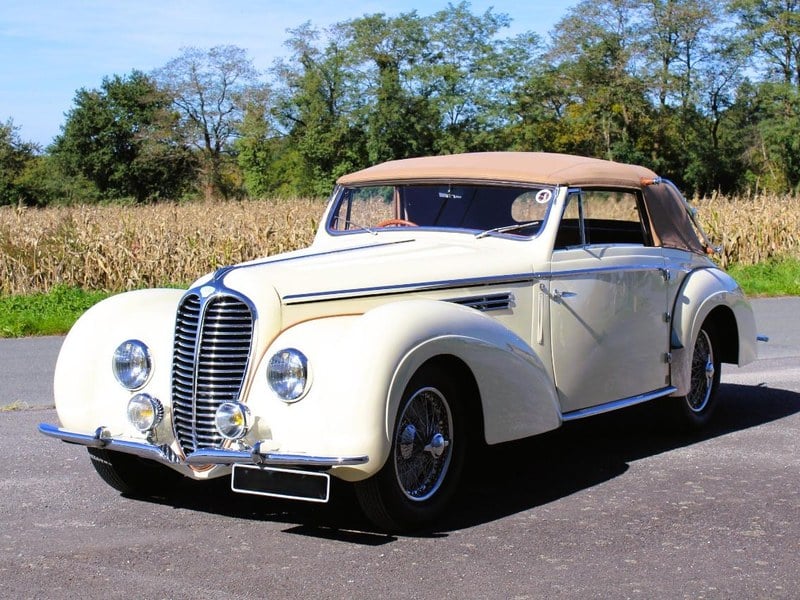
This evolution coincided with the golden age of French coachbuilding. Sold as bare chassis, Delahayes became a favoured canvas for some of the greatest names in the business: Chapron, Figoni & Falaschi, Saoutchik, Letourneur & Marchand, Labourdette, Autobineau, Antem, Guilloré and Dubos. Roadsters, cabriolets, streamlined coupés and concours bodies established an image in which mechanical performance was inseparable from French elegance. The Type 135 would become its most celebrated expression, but the story truly began with the 138.
The 135: The Sporting Culmination
From the 1935 Paris Motor Show onwards, the final 138 Sports were increasingly referred to as 135 Sports. This was less a clean break than a continuous evolution. The 135 retained the principles established by the 138 and progressively developed them further through the Sport, Coupe des Alpes, Compétition and, above all, 135 Spécial versions.
Produced in just sixteen examples between late 1935 and early 1936, the Type 135 Spécial “S” represented the most radical development of this evolution. Its deeply lowered chassis had a wheelbase of only 2. 70 metres, while its Type 103 engine was developed to the limits of its potential. In competition specification, the car could reach approximately 185 km/ h. Entered by the factory, Écurie Bleue and a number of private drivers, the 135 S built its reputation on strength and endurance.
The names of Laury Schell, René Le Bègue, Robert Brunet, Albert Divo, Eugène Chaboud, Jean Trémoulet, Yves Giraud-Cabantous and Louis Villeneuve became closely associated with Delahaye. Success followed in major road races and on circuits. This progression reached its zenith at the 1938 24 Hours of Le Mans, where Eugène Chaboud and Jean Trémoulet won in a Delahaye 135 S/ CS, ahead of another Delahaye, while a third finished fourth. Introduced from 1938 onwards, the 135 MS would subsequently transfer some of the experience gained with these prestigious competition cars to the road.
Jacques Ambaud’s Four Delahayes
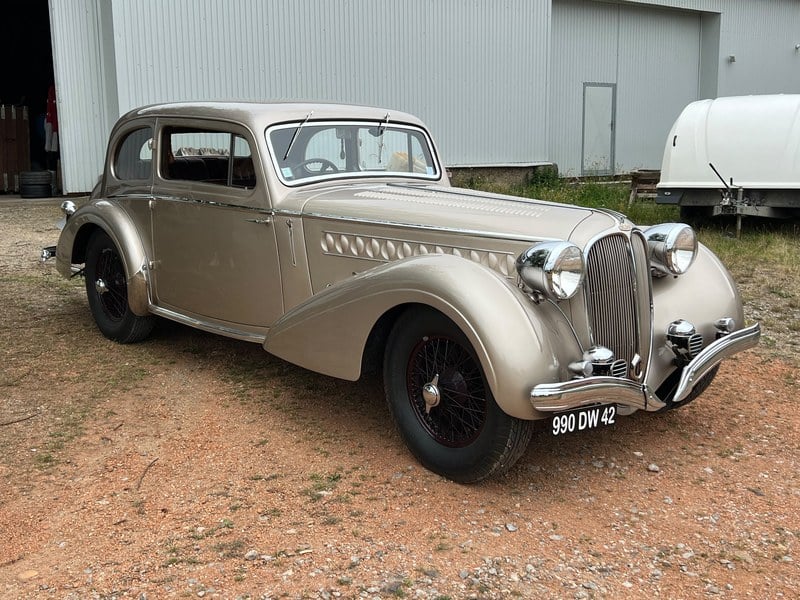
It was precisely during this pivotal period, as the 138 Sport paved the way for the future 135, that Jacques Ambaud entered the story. A wealthy Marseille sportsman and enthusiastic competitor, in June 1935 he placed an exceptional order for four Delahaye 138 Sports, all bodied by Chapron and registered in Paris on the same day under four consecutive registration numbers.
Historical records and subsequent research have made it possible to identify this small series: chassis 45533 – 6200 RJ 8; chassis 45538 – 6201 RJ 8; chassis 45496 – 6202 RJ 8; and chassis 45537 – 6203 RJ 8. All four cars would be entered a few months later in the 1936 Monte Carlo Rally, confirming the distinctly sporting purpose behind this unusual order.
The car presented here is the second of the four: chassis 45538, registered 6201 RJ 8.
A Rare Survivor from the Birth of Delahaye’s Competition Era
The significance of chassis 45538 ultimately lies not in any single aspect of its history, but in the combination of them all. Its identity has been known from new. Its first owner, Paris registration 6201 RJ 8 and Chapron bodywork are documented. Its participation in the 1936 Monte Carlo Rally, where it finished 12th overall, is confirmed by period results. A few months later, it again finished 12th in the 3 Hours of Marseille. Its subsequent provenance can then be traced through the AGACI, Serge Pozzoli, Flavien Marçais, Pierre Honegger, François Cointreau and its current owner.
Above all, however, it belongs to a generation that has become exceptionally rare. Chassis 45538 was built at the precise moment when Delahaye was entering a new era. The 138 Sport had just earned its sporting credentials in the Coupe des Alpes and on the banking at Montlhéry. The 135 was about to appear. The sixteen 135 Spécials would soon carry the marque into Europe’s greatest races, before Delahaye reached the pinnacle of this extraordinary sporting adventure with victory at the 1938 24 Hours of Le Mans.