Description
Chassis No. AM109/ S1615
Engine No. AM109/ S1615
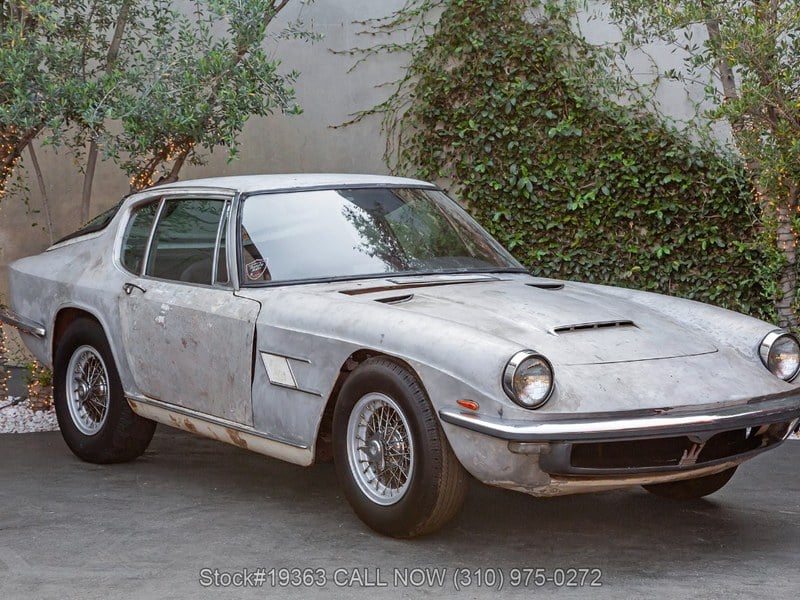
Maserati unveiled the Mistral at the Turin Motor Show in November 1963, with the open Spyder following at Geneva in March 1964. Successor to the 3500 GT, it was the first Maserati named for a wind. The mistral is the dry, forceful wind that sweeps through Provence and clears the sky as it goes. Its name traces back to the Latin word for master, and the naming tradition it started continues at Maserati today. Engineer Giulio Alfieri and stylist Pietro Frua conceived the car as a two-seat answer to the Jaguar E-Type.
Under the hood sat the last of Maserati's twin-plug inline sixes, a close relative of the engine that powered the 250F to Juan Manuel Fangio's 1957 World Championship. It was fed by Lucas mechanical fuel injection, still a novelty among Italian manufacturers, and a ZF five-speed manual sent power to the rear wheels. In 3. 7-liter form, it produced 245 PS. Four-wheel disc brakes and Borrani wire wheels completed the running gear, while the open car's predominantly steel body used aluminum for the hood, doors, and trunk lid. Maserati also offered a rare aluminum hardtop. Just 124 Spyders were completed in total, and only 46 of them were powered by the 3. 7-liter engine.
Built in April 1966, this Spyder was sent to Spain and shown at the 1966 Valencia Motor Show, finished in Oro Longchamps with a Red leather interior. The original show flyer, with the car pictured on its pages, remains with it today. It later returned to Italy, where Juventus defender Antonio Cabrini, a 1982 FIFA World Cup winner, reportedly acquired it. Cabrini spent 13 seasons at Juventus and was later inducted into the Italian Football Hall of Fame.
A new owner acquired the car in 2015 and brought it across the Atlantic to the United States. There, it was shown at the 2017 Amelia Island Concours d'Elegance, where it placed second in class. Following this showing, it was brought to Switzerland, where it was acquired by the current owner.
One of only 46 Mistral Spyders built with the 3. 7-liter six, this is the same car that met the crowds in Valencia in 1966, in the same Oro Longchamps it wears today. With the top folded and the injected engine pulling hard, it delivers the full force of the wind it was named for.