Description
For sale in our forthcoming auction 'Retromobile the Official Sale', on 2 February 2024 :
English title
Chassis n° 109 S * 033*
Engine n°109 S 033
Numero interno n° 2298
- Very detailed history in its early years
- Original engine, original color
- Equipped with original hard-top and air conditioning
- Superb condition, High-quality restoration
- From an important European Collection
- Equipped with original hard-top and air-conditioning
Thanks to the archives rediscovered by Adolfo Orsi, who manages the brand's history, it is possible to retrace in detail the entire genesis of this Maserati Spyder, one of the first in the series, just after the 3500 GT.
The first trace we have of it dates back to September 11, 1964, when Auto-König, the brand's Munich-based importer in Germany, sent us an order for a "Frua Convertible 3. 5 iniezione" (the name Mistral came a little later), in "Eurolac Bleu Sera metallizzato 106-A-18" color, with "PAC 1775" leather upholstery, black soft top, body-colored hard-top, air conditioning and passenger grab handle, with delivery requested between mid and late October. The letter was signed by Herbert Weiger, Plant Manager. Two days later, a second letter confirms the order, this time described as "Maserati Gran Turismo 3500/ GTI, carrozzata convertible". An internal Maserati production order followed on September 14, and on the same day a letter from Maserati to Carrozzeria Allemano, confirming the order. While Frua designed the body, the panels were prepared at Maggiore in Turin, and assembly and painting were carried out by Allemano, at least during the initial production period. On September 24, Auto-König requests the addition of seat belts, and on October 3, an internal Maserati memo specifies that the seats should be foldable. On November 23, a dispatch note describes the Maserati Spyder to be exported via the Brenner Pass customs post between Italy and Austria, and on the same day an invoice is issued to Auto-König for DM 32, 330. These documents were issued before the car was officially completed, no doubt for export-related administrative reasons.
The production sheet issued on November 24, 1964 lists a "Convertible Allemano Tipo 109", chassis and engine no. 109. 033, 117th in the series, ZF gearbox, Pirelli 185x16 tires, Borrani spoked wheels, Fiamm battery. Finally, on December 4, a warranty certificate was issued for the car bearing chassis no. 109. S. 033 in the name of the first buyer, Mr. Hubertus Liebrecht of Ingelheim/ Rhein. Hubertus Liebrecht's family, then aged 23, headed the Boehringer Ingelheim pharmaceutical laboratories. Hubertus Liebrecht established the Boehringer Ingelheim Foundation in 1977.
On February 20, 1965, following an accident with damage mainly to the rear, the car was sent back to Modena for repairs. Still owned by Hubertus Liebrecht, it clocked up 7, 328 km, and the Auto-König letter recalled the repairs under warranty and requested that the car be returned "as new", with full paintwork if necessary. On April 9, 1965, Maserati issued an invoice for 457, 912 lire, for disassembly of the tank and the entire rear bodywork, and full paintwork.
On March 18, 1969, the Spyder Maserati returned to customer service for repairs, with the odometer reading 37, 968 km. The document listing the work to be carried out is in the name of the new owner, Mr. Werner Pohl of Waldkraiburg, Germany, and mentions repairing the rev counter, recharging the air-conditioning system, adjusting the ignition and carburetion, treating a leak in the Lucas injection system, checking the brakes and eliminating a smell of petrol in the car. The following invoice, dated March 28, 1969, amounts to 228, 024 lire. It is the last document included in the Maserati archives concerning this car.
The car then made its way to the USA, where it was found again in 1997. It was then part of the collection of Hans Huwyler, based in South Carolina.
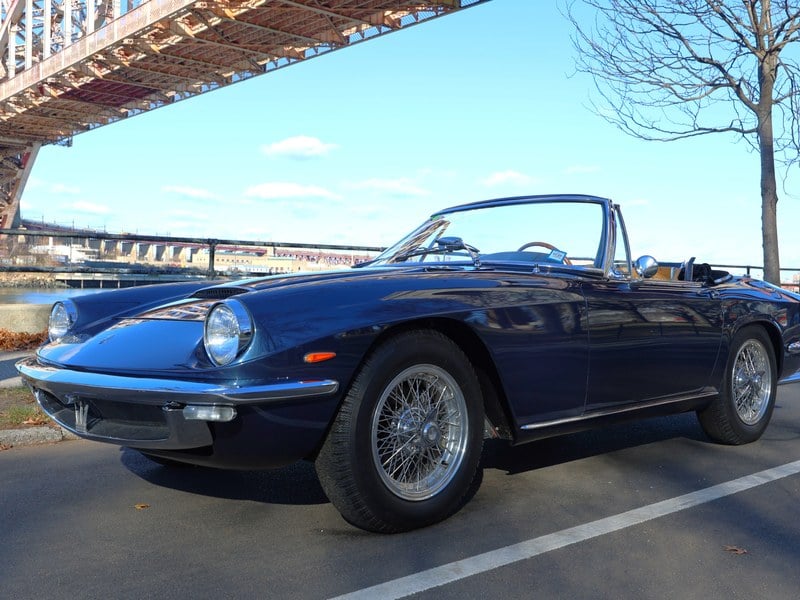
Today, the car is equipped with Lucas injection, which was overhauled when it was still in the USA. In the hands of the new owner, the car has been fully restored by a careful keeper. The mechanic and the bodywork have been completely overhauled. The car is now in superb condition, with its original dark blue color and magnificent light brown leather upholstery. It still has its original air-conditioning system, the hard-top with which it was delivered new, and the passenger grab handle ordered at the time. With its smooth and powerful 3. 5-liter fuel-injected 6-cylinder, this competitor to the Ferrari 250 GT is emblematic of the most prestigious Italian cabriolets of the 60s. Its design by Frua and its Allemano convertible body make it even more exclusive and rare, as no more than 125 Mistral Spyders have ever been built and even more, just 12 of them with 3, 5 l engine. An opportunity not to be missed, for enthusiasts of the genre.